
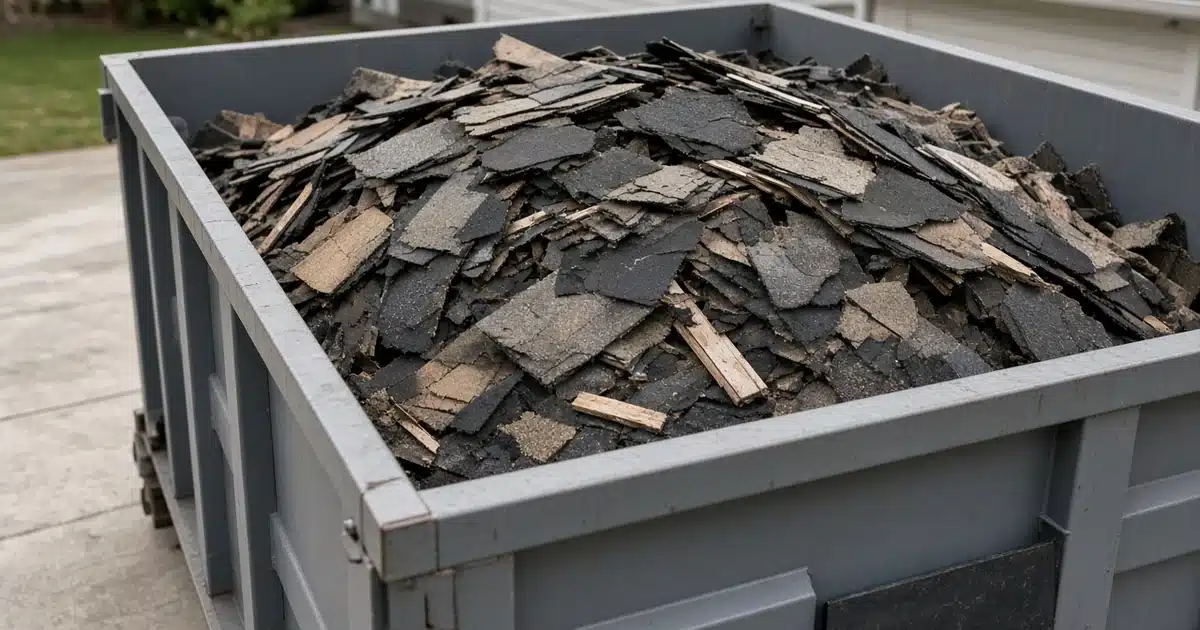
Roofing tear-off debris fills a disposal bin faster by weight than by looks. Asphalt shingles, underlayment, and flashings are dense, especially when damp from Lower Mainland weather. Trash King delivers DIY roll-off bins across Greater Vancouver and Metro Vancouver. Roofing crews or homeowners load the tear-off. Then we haul the bin. We are not a roofing labour crew and not a junk-removal labour crew. This guide covers what typically goes in a roofing-focused bin, what to confirm before loading, and how to avoid an over-weight surprise. See also: roofing tear-off.
What this service is (and is not)
This is a DIY roll-off or disposal bin for tear-off debris your crew loads from the roof and the ground staging area.
This is not shingle stripping, tarping, or a crew that carries material for you.
If you need roofers, hire roofers. If roofers (or you) will load a container, DIY roll-off fits. Size context: trash bins.
Who this guide helps
- Homeowners replacing asphalt shingle roofs
- Roofing contractors staging tear-offs on residential streets
- Property managers coordinating reroof schedules
- Anyone tempted to bury random garage junk under shingle piles
Decision framework for roofing bins
- Estimate squares and layers. Multiple layers of shingles multiply weight quickly. Say how many layers you expect.
- Name the roofing type. Asphalt shingles, cedar, torch-on, metal panels, and tile do not behave the same for handling and routing. Confirm when you call.
- Plan ground staging. Keep a clear path from drop zone to bin so DIY loading stays safe.
- Prefer driveway placement when the lot allows. Confirm municipal rules before street placement.
- Call 604-433-5865 with roof size, material, and access notes. Ask about current delivery availability when you call.
What commonly goes in a roofing tear-off bin
Often loaded (still confirm your specific mix when booking):
- Asphalt shingles and associated underlayment from the tear-off
- Roofing nails and small scrap generated with the shingles
- Packaging from new materials if volumes are modest and allowed in the same plan
Often better as a separate conversation:
- Large metal flashings or panels destined for cleaner metal recycling streams when separated
- Dimensional lumber from major plywood deck replacements. See wood mindset if volumes are high
- Household junk from a simultaneous garage cleanout (do not contaminate a roofing load casually)
- Hazardous leftovers (coatings, solvents). Confirm. Do not assume
This is planning guidance, not a universal accepted or banned list. Facility rules vary.
Weight, weather, and overfill
Shingles stack heavy. Rain adds more weight. A bin that looks only partly full can already be at a practical limit. Load flat and even. Do not peak above the rim. If the tear-off will exceed one bin, plan a swap on the day layers come off, not the morning after the driveway is buried.
Old roofs may involve materials that need testing or special handling (for example, older buildings and hazardous concerns). When unsure, pause and get appropriate guidance before loading.
Which bin to use for roofing
Roofing uses a 20 yard bin, call for price. See the bin rental prices page. For a 12 yard bin, call 604-433-5865 to confirm the included weight and rental days.
Concrete, dirt, drywall and clean fill do not go in a 20 yard or larger mixed waste bin. Each of those materials goes in its own 12 yard bin, call for price.
Chimney rebuilds above the roofline
Above-roofline chimney rebuilds leave brick, flue tile and caps. Brick and mortar are dense masonry. Metal caps can go to scrap. Flue tiles are not bottle glass. Mortar chunks are treated as masonry.
Stage the load on the ground. Keep it off fragile roof edges.
When brick and mortar dominate, they go in their own 12 yard heavy bin, call for price. See the bin rental prices page. Mixed residue after the heavy pull can go in a mixed waste bin.
Rooftop decks
Rooftop deck work leaves pavers, pedestals and waterproofing offcuts. Pavers follow heavy-bin rules when the volume is high. Pedestals are usually plastic and can go as mixed waste.
Membrane offcuts and adhesives need the same caution as coating waste. Solvents go to a Product Care path, not into the bin.
Tell us the paver volume when you book. Plan a heavy bin for the masonry, then a mixed waste bin for the non-masonry residue if needed. When pavers dominate, they go in their own 12 yard bin, call for price. See the bin rental prices page.
Metal roofing panels
Standing-seam and screw-down panels are good scrap once they are free of underlay and wood. Keep fasteners and painted flashing sorted. Underlay and rotten nailers go as mixed debris. Part-full sealant tubes go to a Product Care depot.
Pull the metal for scrap first, then load the leftover roofing debris. Tell us the panel length when you book.
Skylights and solar tubes
Domes, glass units, flashing and shaft liners often come out during a roofing job. Give each its own pile first. Metal flashing can go to scrap. Acrylic domes are usually mixed waste. Old sealant and solvent cans go to a Product Care depot.
Drywall stamped 1990 or newer, or with a clean lab report, is accepted in its own bin, call for price. Older or undated drywall needs a lab report showing no asbestos, plus the required declaration. See the bin rental prices page. Other skylight debris can go in a mixed waste bin.
Ice dams and gutter cleanouts
These cleanups drop leaves, shingle grit, nails and the odd piece of flashing. Leaves can go to green waste where they are accepted. Nails and screws spoil green waste and can puncture tires, so sweep them up before bagging leaves. Asphalt shingle tabs are not green waste.
Mixed gutter debris that is not organic can go in a mixed waste bin. A large amount of grit counts as dirt and goes in its own 12 yard bin, call for price. See the bin rental prices page. Mention it when you book. Dirt stays in its own bin. Do not mix it with concrete, drywall or clean fill.
Roof sheathing replacement
Rotten roof sheathing adds plywood volume on top of the shingle tear-off. Count full sheets and partial sheets as you pull them. Keep shingles and felt separate. Compare that sheet count to the deck area you are replacing so one bin is not planned from the shingles alone.
Clean, untreated sheathing may qualify as clean wood when it is dry and free of roofing felt and shingles. Rotten, painted or contaminated plywood usually rides as mixed roofing debris. Ask when you book how to separate the layers.
Sequencing with other trades
Roofing often lands between demo and interior work. If siding or framing debris will share the same week, decide whether one bin and one swap beats two overlapping containers. Site supers should own that call. Trash King supplies the container logistics.
Safety around tear-off debris
Nails and sharp flashing belong in the bin, not on the lawn. Keep a magnet sweep habit if kids or pets use the yard. Load from staging tarps when possible to protect driveways.
Site logistics for Vancouver-area tear-offs
- Protect landscaping and walkways along the toss or load path if needed.
- Tell dispatch about steep pads, shared driveways, and overhead wires.
- Coordinate bin arrival with the tear-off day so material is not double-handled.
- Keep kids, pets, and parked cars out of the drop and load zone.
- Regional coverage: Greater Vancouver municipalities Trash King lists. Ask on boundary addresses.
Practical tips
- Count roof squares roughly before you call. “Medium house” is harder to quote against.
- Mention torch-on, cedar, or metal explicitly. Those change the conversation versus standard asphalt.
- Separate obvious non-roof junk before the first shingle lands in the bin.
- Hours: Monday to Friday 9:00 to 19:00, Saturday to Sunday 9:00 to 17:00 (America/Vancouver). Email: quotes@trashking.ca.
Next step
For a reroof anywhere in Metro Vancouver, pair crew labour with a correctly planned DIY bin. Review roofing tear-off and trash bins, then call 604-433-5865. Ask about current delivery availability when you call.
FAQ
Do you tear off the roof and load the bin?
No. DIY roll-off only. Your roofing crew (or you) loads. Trash King is not a roofing or junk labour crew.
Can all shingles go in one bin?
Often that is the plan for asphalt tear-offs, but layers, moisture, and contaminants matter. Confirm weight expectations when you call.
What about old roofs and hazardous materials?
If you suspect hazardous materials, do not guess. Get appropriate testing or guidance before loading. Confirm special items when you book.
Driveway or street for a roofing bin?
Driveway or private pad preferred. Confirm municipal rules before street placement.
Can I get a bin for a tear-off starting today?
Ask about current delivery availability when you call.
Is roofing bin pricing online?
Roofing uses a 20 yard bin, call for price. See the bin rental prices page. Bobby confirms the price when he calls on 604-433-5865.