
If you have a truck or a trailer, a dump run looks like the obvious choice. Load up, drive to the transfer station, tip it and go home. For a small, sorted load, it often is the right call.
For a bigger job, the trips add up. Every load has to be lifted twice, tied down, driven, sorted at the scale and unloaded by hand. A roll-off bin is the other option if you’d rather skip the trips: you load, we haul.
Short answer: a dump run suits one small, sorted load, and a bin suits a job that takes several trips or more than a day. The comparison below uses Metro Vancouver’s own rules for its recycling and waste centres. Whichever you pick, the lifting is yours. With a bin, Trash King delivers it and hauls it away.
The Vancouver transfer station and other public drop-off sites
Metro Vancouver and the City of Vancouver run the region’s public recycling and waste facilities. Residents can bring garbage and recycling to:
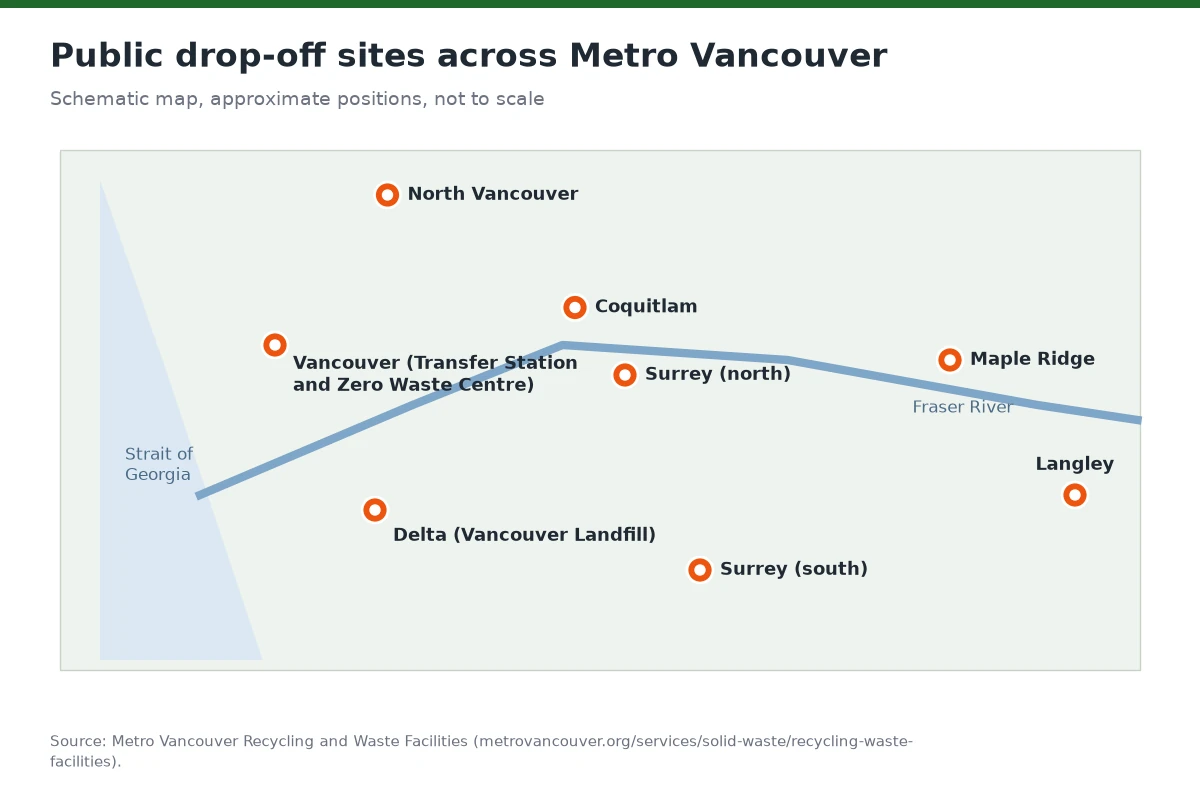
- North Shore Recycling and Waste Centre, North Vancouver
- United Boulevard Recycling and Waste Centre, Coquitlam
- Central Surrey and North Surrey Recycling and Waste Centres, Surrey
- Langley Recycling and Waste Centre
- Maple Ridge Recycling and Waste Centre
- Vancouver Landfill and Recycling Depot, in Delta
- Vancouver South Transfer Station (377 West Kent Ave North) and Vancouver Zero Waste Centre, Vancouver
The Waste-to-Energy Facility in Burnaby takes commercial disposal only. Each site posts its own hours. Maple Ridge and Langley, for example, are open 8 am to 5 pm Monday to Saturday in winter and 9 am to 5 pm on Sundays. The North Shore centre lists weekday peak hours of 10 am to 2 pm. Avoid that window if you can.
What a dump run really involves
Sorting before you go
Most sites split into two areas: a free recycling area and a paid area for garbage and paid recycling. At North Shore and United Boulevard, for example, the free depot sits ahead of the scales and takes items like batteries, electronics, cardboard, metal and plastic containers. Yard trimmings, clean wood, gypsum and mattresses are recycled for a fee.
That means a mixed load gets unloaded in more than one place. Plan your truck so the recycling comes off first.
Inspections and surcharges at the scale
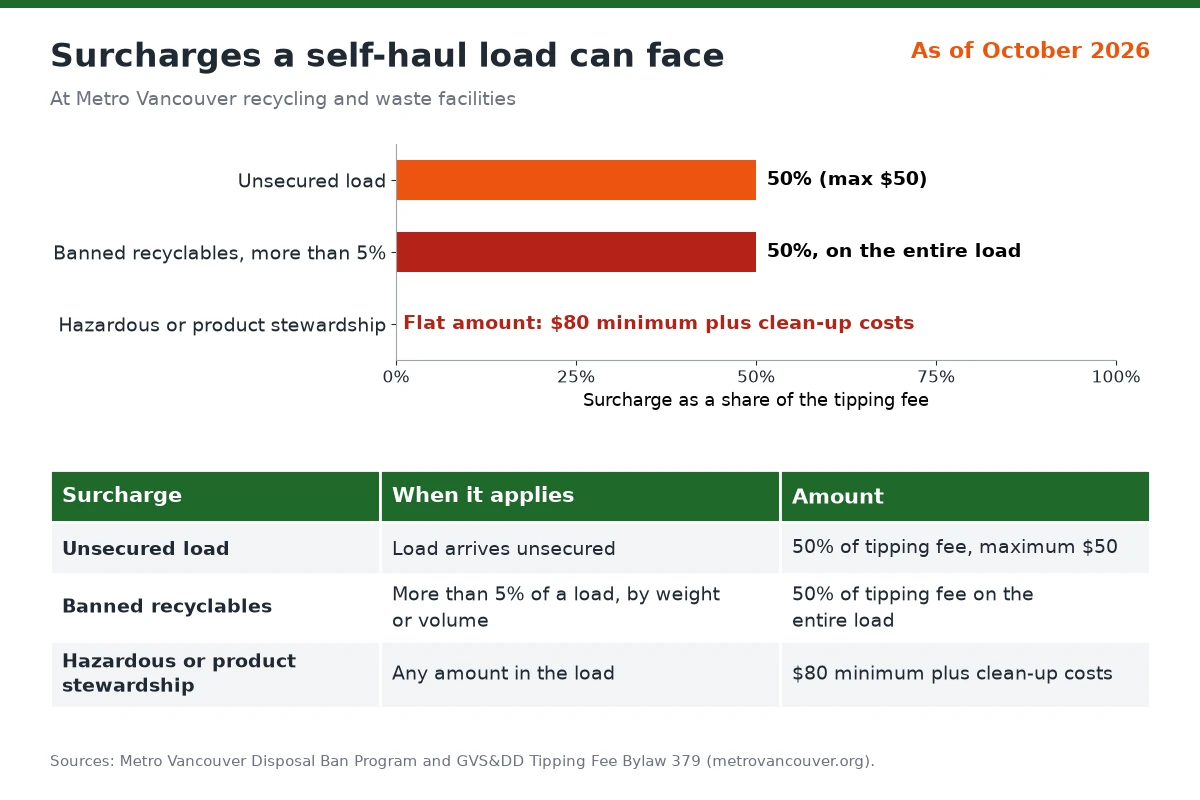
Loads are inspected for banned materials. Under the Disposal Ban Program, a garbage load gets a surcharge of 50% of the tipping fee on the whole load when banned recyclables, such as cardboard or clean wood, make up more than 5% of a load by weight or volume. A single hazardous or product stewardship item, such as a propane tank or a can of paint, can trigger an $80 minimum surcharge plus any clean-up costs. Our guide to Metro Vancouver disposal bans lists the common ones.
Tying the load down
Metro Vancouver’s Tipping Fee Bylaw adds a surcharge for unsecured loads: 50% of the tipping fee, to a maximum of $50. Use a tarp or cargo net and straps on every trip, not just the windy ones.
Size limits
Single objects over 100 kg, 2.5 metres long or 1.2 metres wide are banned from the garbage at Metro Vancouver facilities. Big items such as a hot tub, a long beam or a large slab need to be broken down either way.
Your time and your back
Every item gets lifted into the truck, then out again at the site. A bigger cleanup can mean several trips, each with a drive, a lineup and a scale stop. Tipping fees are set by bylaw and rates vary by facility, so check the current rates before you go.
What a bin rental involves
With a roll-off, the work happens at home.
- One delivery. We drop the bin on your driveway or pad. Tell us about new, stamped or steep driveways. See protecting your driveway. Our homeowner’s bin prep guide covers the rest of delivery day.
- One lift. Each item goes from the house straight into the bin. No second unload at the other end.
- Your schedule. Load in the evening, over a weekend, or across a reno. See how long you can keep a rental bin.
- One pickup. Call when you’re done and we haul it away.
The ban list still applies to what’s in the bin. Paint, propane tanks, fuel and tires never go in it. Take paint to a Product Care Recycling drop-off and tires to a Tire Stewardship BC return site, and use the Metro Vancouver Recycles directory for the rest.
If the bin can’t fit on your property and needs to go on the street, check with your city about a permit first, since rules and timelines change often.
Side by side
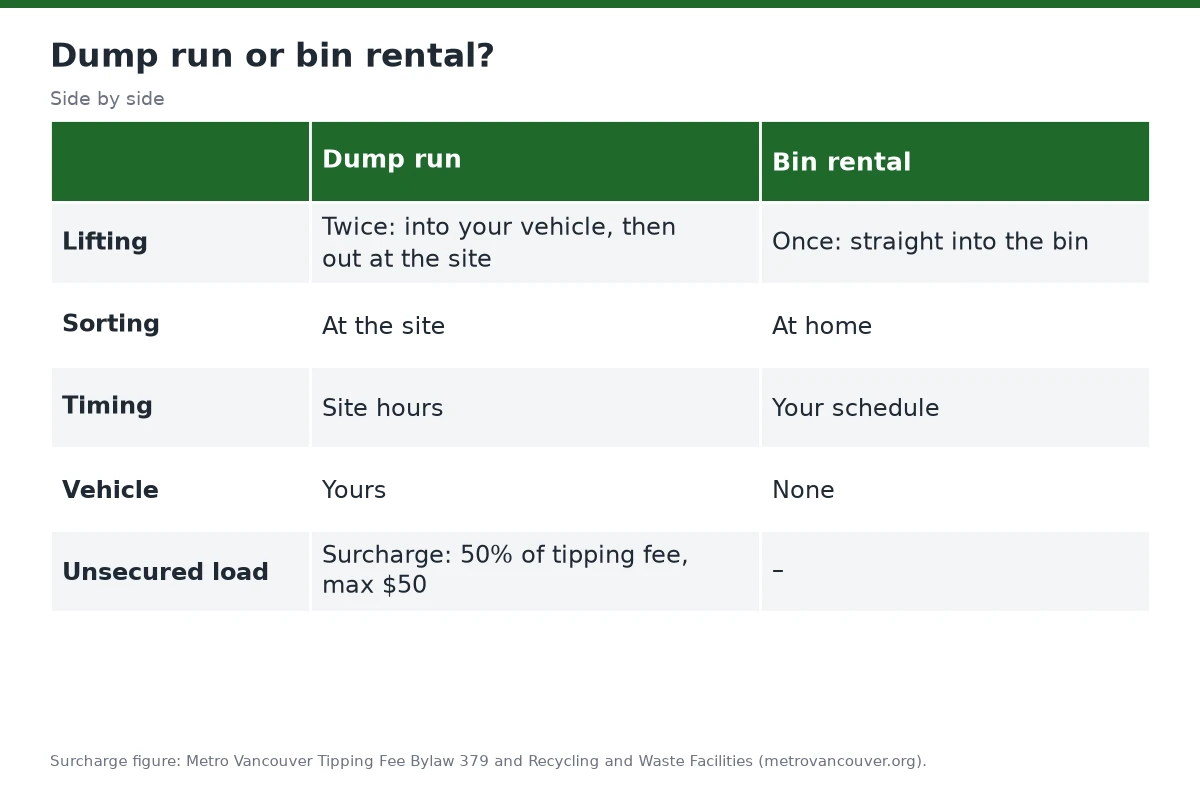
| Dump run | Bin rental | |
|---|---|---|
| Best for | A small load you can carry in one or two trips | A multi-day cleanout or reno |
| Vehicle | Your truck or trailer, tied down | None needed |
| Lifting | Twice per item (in, then out) | Once per item |
| Sorting | At the site, across recycling and garbage areas | At home, before you load |
| Timing | Site hours and lineups | Your schedule during the rental |
| Cost to plan for | Posted tipping fees, plus any surcharges | A quote from Trash King for size, materials and rental time |
When a dump run makes more sense
- You have one load or less, and it’s already sorted.
- Most of it is free recycling, such as cardboard, metal or electronics.
- You already own a truck or trailer and the straps to secure it.
- There’s no room on your property for a bin.
When a bin makes more sense
- The job will take more than a day, such as a reno, a garage cleanout or a move.
- You’d need several trips to clear it.
- There’s heavy or awkward debris you’d rather lift only once.
- You don’t have a truck, or don’t want to borrow one.
A mixed approach works too. Some people run the free recycling to the depot and put everything else in the bin.
How to get a bin quote
Our post on what affects a bin rental quote explains the five things we ask about: size, material, weight, rental length and access. Call 604-433-5865 or email quotes@trashking.ca with a rough list of what’s going, and see our disposal bins page for how the service works.
FAQ
Where is the nearest transfer station in Metro Vancouver?
Metro Vancouver lists public recycling and waste centres in North Vancouver, Coquitlam, Surrey, Langley and Maple Ridge, plus the Vancouver Landfill in Delta and the City’s Vancouver South Transfer Station on West Kent Ave North. Check each facility’s page for hours.
Is a dump run cheaper than a bin?
It depends on the size of the job. One sorted load is often simplest as a dump run. For several loads, compare the posted tipping fees and your time against a bin quote.
Do I have to tarp my load to the dump?
Yes. Metro Vancouver adds a surcharge for unsecured loads of 50% of the tipping fee, to a maximum of $50.
Can I take a mattress to the transfer station?
Some sites, including North Shore, United Boulevard and the City’s Vancouver South Transfer Station, recycle mattresses for a fee. Check the posted fee before you go. Don’t hide one in a garbage load. If you rent a bin instead, a mattress can be added for an extra fee.
What can’t go in a bin or a dump run?
Paint, propane tanks, fuel, tires, batteries and other hazardous products. Use the matching drop-off program instead.
Sources
- Metro Vancouver, Tipping Fee page (fees starting July 1, 2026: garbage $182 per tonne under 1 tonne, yard trimmings and clean wood $139 per tonne, $15 minimum per load off-peak and $25 at weekday peak 10 am to 2 pm, peak rule not applied at Central Surrey, Langley and Maple Ridge, as of October 2026): https://metrovancouver.org/services/solid-waste/tipping-fee (checked 2026-10-30)
- Metro Vancouver, Recycling and Waste Facilities (site list, Waste-to-Energy commercial only): https://metrovancouver.org/services/solid-waste/recycling-waste-facilities (checked 2026-10-29)
- City of Vancouver, Vancouver South Transfer Station (address, accepted materials, mattresses for a fee, 2026 surcharges): https://vancouver.ca/home-property-development/transfer-station.aspx (read 2026-10-30)
- Metro Vancouver, Maple Ridge Recycling and Waste Centre (winter hours): https://metrovancouver.org/services/solid-waste/maple-ridge-recycling-and-waste-centre
- Metro Vancouver, Langley Recycling and Waste Centre (winter hours): https://metrovancouver.org/services/solid-waste/langley-recycling-and-waste-centre
- Metro Vancouver, North Shore Recycling and Waste Centre (peak hours): https://metrovancouver.org/services/solid-waste/north-shore-recycling-and-waste-centre
- Metro Vancouver, 2024 Solid Waste System Fact Sheets (free depot ahead of scales, fee recycling for yard trimmings, clean wood, gypsum, mattresses): https://metrovancouver.org/services/solid-waste/Documents/solid-waste-system-fact-sheet.pdf
- Metro Vancouver, Disposal Ban Program (surcharges, single-object limits): https://metrovancouver.org/services/solid-waste/disposal-ban-program
- Metro Vancouver, Tipping Fee Bylaw No. 379 (unsecured load surcharge, Table 4): https://metrovancouver.org/boards/Bylaws/GVSDD_Bylaw_379_Consolidated.pdf
- Product Care Recycling: https://www.productcare.org/products/paint/british-columbia/ · Tire Stewardship BC: https://tsbc.ca/recycle-your-tires/ · Metro Vancouver Recycles: https://recycling.metrovancouver.org/