
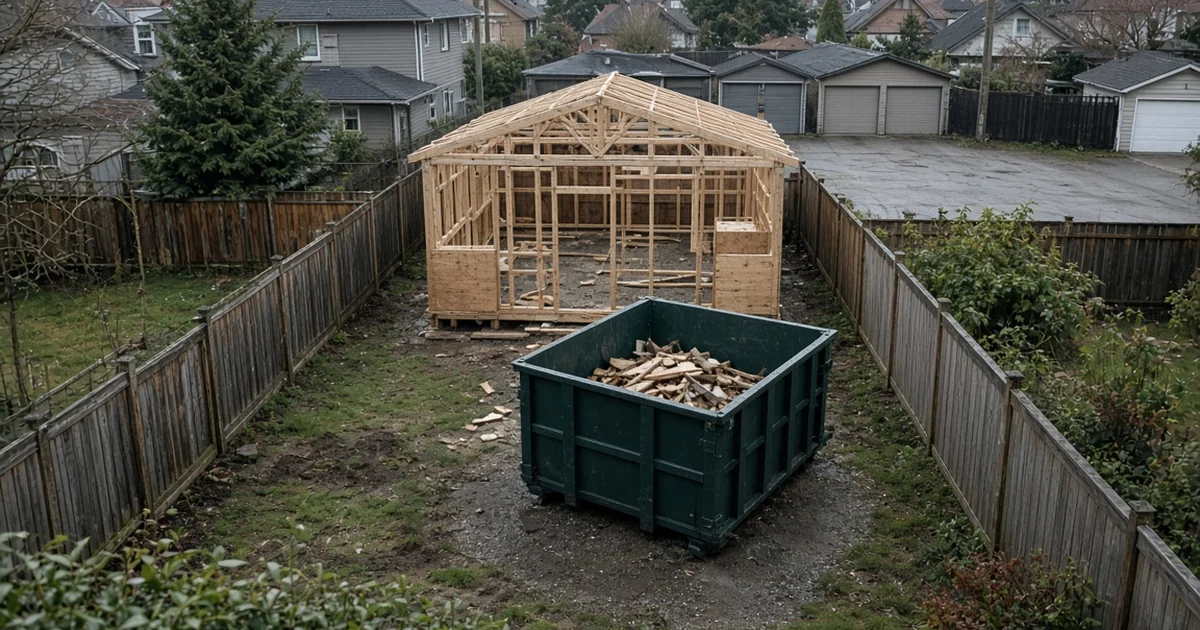
A laneway house or garden suite is a full new build squeezed into a backyard. That means the same waste as any new home, from soil to framing offcuts to drywall scraps, but with much less room to park a bin. Planning bins by phase keeps the yard workable and the loads clean.
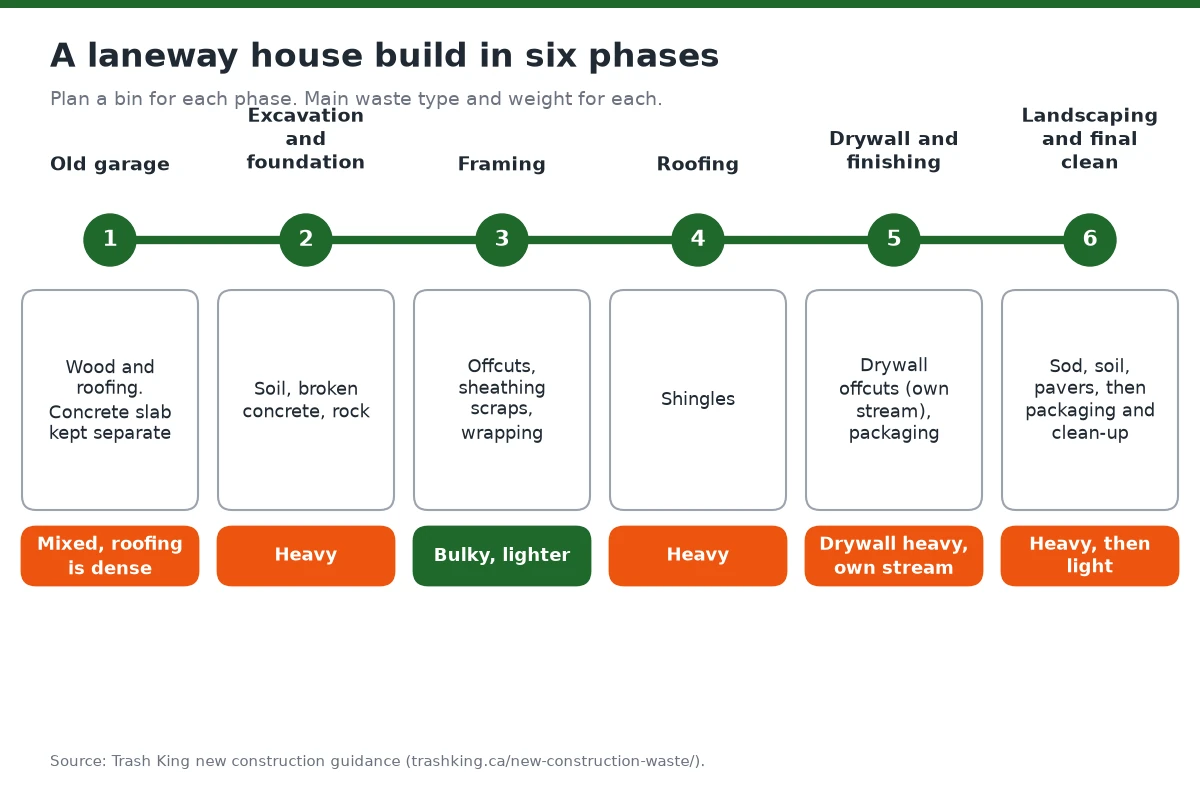
The phases below run from the old garage to the final clean-up. You or your crew handle the loading. Trash King delivers each bin and hauls it away when you call.
Start with permits and the site plan
In Vancouver, the City lists the steps for a new laneway house. You apply for a sewer and water connection permit before the development and building permit. If you’re taking down an existing building, such as an old garage, you also need a demolition permit. Work has to begin within 6 months of permit issue, or the permit becomes invalid. Other Metro Vancouver cities have their own rules for laneway homes, coach houses and garden suites, so check with yours.
When your designer draws the site plan, mark where the bin will sit in each phase. Space for a bin is easy to lose once materials, a porta-potty and a fence go up.
Where the bin goes on a laneway build
If your build sits at the back of the lot next to the lane, the lane may be the easiest truck access. It’s also public property.
- On your lot. A pad on the front driveway or a cleared spot off the lane on your own property keeps the bin out of the City’s way. Leave room for the truck to set it down and pick it up.
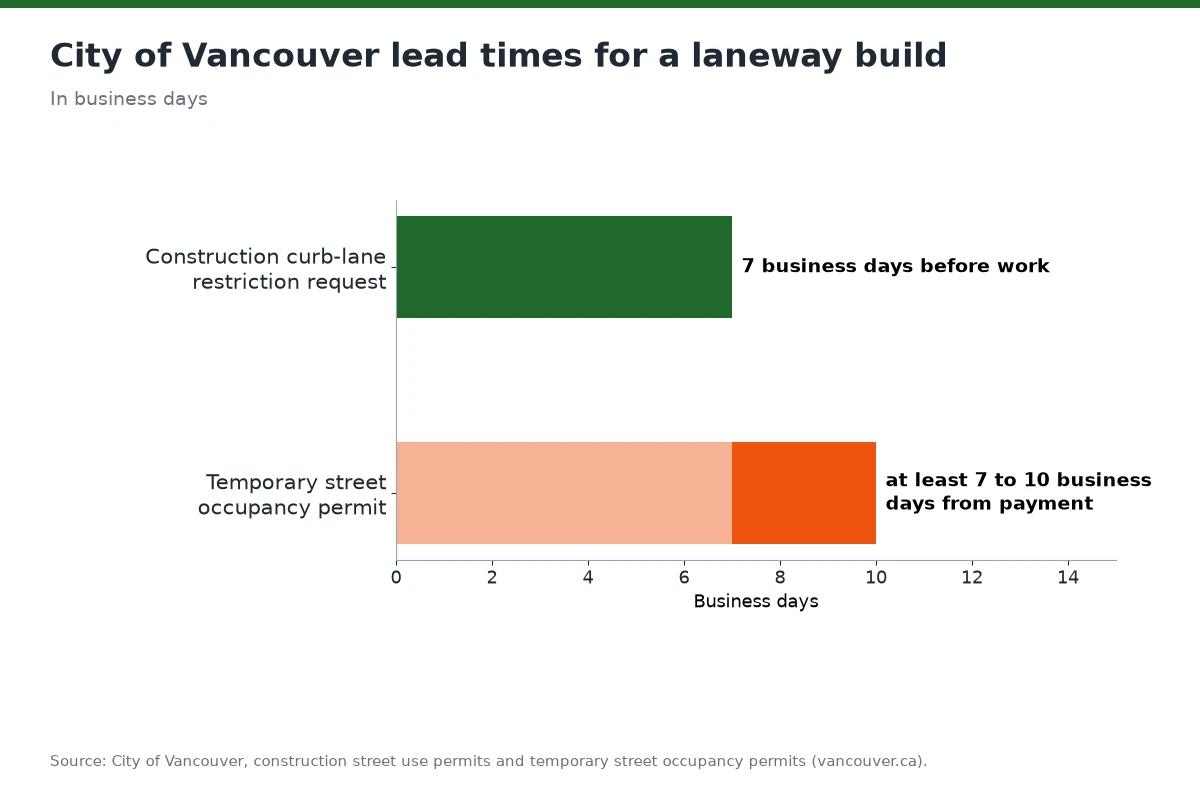
- In the lane or on the street. In Vancouver, a bin on the street or in a rear lane needs a permit first. The City’s temporary street occupancy page says to allow at least 7 to 10 business days from payment, and lane use fees apply. For construction work, the City says requests to restrict a curb lane for deliveries or other construction purposes must go in 7 business days before work starts.
- In Burnaby. The City of Burnaby doesn’t allow container placement in lanes at all.
Check with your city before you book, since rules and timelines change often. Then call 604-433-5865 or email quotes@trashking.ca and we’ll plan delivery around your permit dates.
Phase 1: The old garage
Many laneway builds start by taking down a garage. WorkSafeBC says homes built before 1990 likely contain asbestos, and newer ones can too. Its list of materials that can contain asbestos includes roofing shingles, stucco and drywall filling compound. Have a licensed asbestos surveyor test before demolition. If the test finds asbestos, a licensed abatement contractor removes it before the rest comes down. A DIY bin is never the place for asbestos.
Garage contents come out before the walls. Paint, propane, fuel and tires never go in the bin. Take paint to a Product Care Recycling drop-off and tires to a Tire Stewardship BC return site, and use the Metro Vancouver Recycles directory for propane and fuel.
The garage debris itself is mostly wood, roofing and maybe a concrete slab. Keep the concrete separate (see Phase 2).
Phase 2: Excavation and foundation
This is the heaviest phase. Soil, broken concrete from an old slab and rock fill a bin’s weight limit long before it looks full. Metro Vancouver bans inert fill over 0.5 cubic metres from its garbage facilities, so soil and concrete each go in their own separate bin. A 10-yard or 12-yard is the usual pick for soil or concrete. See our concrete page.
Vancouver’s laneway steps also note that you need a Movement Certificate from the Canadian Food Inspection Agency if you’ll move soil or plant material out of the Japanese beetle regulated area. Check whether your address is inside it before soil leaves the site.
Phase 3: Framing
Framing weeks produce offcuts, sheathing scraps, wrapping and fastener packaging. Mention treated or painted wood when you book, since it needs special handling. Clean, untreated wood is a banned recyclable in Metro Vancouver garbage, and when banned recyclables make up more than 5% of a load by weight or volume, the whole load carries a surcharge of 50% of the tipping fee. If most of your waste is clean lumber, ask us about a wood route. Our new construction waste page covers framing-phase loads.
Phase 4: Roofing
Shingles are dense. If the roofing crew shares the framing bin, tell us how many squares are coming off or going on, so we can plan for weight.
Phase 5: Drywall and finishing
Gypsum is on Metro Vancouver’s list of hazardous and operational-impact materials and is banned from garbage at its facilities, so drywall offcuts go in their own separate bin. See our drywall page. Packaging from cabinets, fixtures and flooring also arrives in this phase. Flatten cardboard before it goes in.
Leftover paint, adhesives and sealants go to drop-offs, not the bin.
Phase 6: Landscaping and final clean
Once the suite is up, the yard gets rebuilt. Sod, soil and broken pavers are heavy and need the same separate plan as Phase 2. The last bin is usually lighter: packaging, offcuts and site clean-up.
One bin or one per phase?
A laneway build runs for months, and the waste changes every few weeks. Our construction guide notes that some crews prefer one larger bin for a concentrated week, while others prefer a mid-project swap so the site stays walkable. Ask about a bin swap when one fills during a busy week. Our construction bin rental guide explains how to size by phase rather than by floor area.
Bins for building waste come in 15, 20, 30 and 40 yards. Sizes are approximate and vary a little between bins. The 10-yard and 12-yard are for soil and concrete. Framing and finishing waste go in a 15-yard or larger when the site allows. See all trash bin sizes.
Keep the site working
- Name one person on site who decides what goes in the bin.
- Post a do-not-load list by the bin: paint, propane, fuel, tires, chemicals and anything waiting for an asbestos result.
- Keep loads below the rim. An overfilled bin waits on site until someone fixes the load.
- Cover for big storms. Bins have drainage holes, so ordinary rain drains out. Cover the load only when a serious rainstorm is forecast, and take the tarp off before pickup.
- Keep the lane clear for neighbours and the truck.
For the first delivery, run through our first-delivery checklist.
FAQ
What size bin do I need for a laneway house build?
It changes by phase. Heavy excavation goes in a 10-yard or 12-yard, and framing or finishing goes in a 15-yard or larger if the site allows. Call with the phase and the site layout.
Can soil from the dig go in a regular bin?
Keep it separate. Metro Vancouver bans inert fill over 0.5 cubic metres from its garbage facilities. Ask us about a dedicated bin.
Can the bin go in the lane behind my lot?
In Vancouver, a bin in the lane needs a City permit first. In Burnaby, containers aren’t allowed in lanes. Check with your city.
Do I need an asbestos test before taking down my garage?
WorkSafeBC says homes built before 1990 likely contain asbestos, and newer ones can too. Test first with a licensed surveyor.
Does Trash King load the bin?
No. You or your crew load it. We deliver, swap and haul.
Sources
- City of Vancouver, Build a new duplex, single detached house, or laneway house (sewer and water permit first, demolition permit, 6-month start, construction street use and temporary street occupancy permits, CFIA Movement Certificate for Japanese beetle area): https://vancouver.ca/home-property-development/build-a-new-duplex-single-detached-house-or-laneway-house.aspx (checked 2026-10-29)
- City of Vancouver, Construction street use permit (curb-lane restriction requests 7 business days before work): https://vancouver.ca/home-property-development/construction-street-use-permits.aspx
- City of Vancouver, Temporary street occupancy permits (7 to 10 business days from payment, lane use fees): https://vancouver.ca/streets-transportation/reserve-metered-spaces.aspx (checked 2026-10-29)
- City of Burnaby, Temporary Container Placement (no placement in lanes): https://www.burnaby.ca/services-and-payments/roads-and-traffic/traffic-requests/temporary-container-placement (checked 2026-10-29)
- Metro Vancouver, Disposal Ban Program (inert fill over 0.5 m3, clean wood banned recyclable with 50% surcharge above 5%, gypsum on the hazardous and operational-impact list): https://metrovancouver.org/services/solid-waste/disposal-ban-program (checked 2026-10-29)
- Metro Vancouver, GVS&DD Bylaw 379 (consolidated), s.7.9 (surcharge applies when banned recyclables are more than 5% of a load by weight or volume): https://metrovancouver.org/boards/Bylaws/GVSDD_Bylaw_379_Consolidated.pdf (checked 2026-10-30)
- WorkSafeBC, asbestos campaign (pre-1990, newer homes, licensed surveyor and abatement): https://www.worksafebc.com/en/about-us/news-events/campaigns/asbestos
- WorkSafeBC news release (shingles, stucco, drywall filling compound listed): https://www.worksafebc.com/en/about-us/news-events/news-releases/2022/October/homeowners-share-responsibility-in-protecting-workers-from-asbestos-exposure
- Trash King, New construction waste (phase-based sizing, 10 or 12-yard for soil and concrete): https://trashking.ca/new-construction-waste/ (checked 2026-10-29)
- Product Care Recycling: https://www.productcare.org/products/paint/british-columbia/ | Tire Stewardship BC: https://tsbc.ca/recycle-your-tires/ | Metro Vancouver Recycles: https://recycling.metrovancouver.org/