
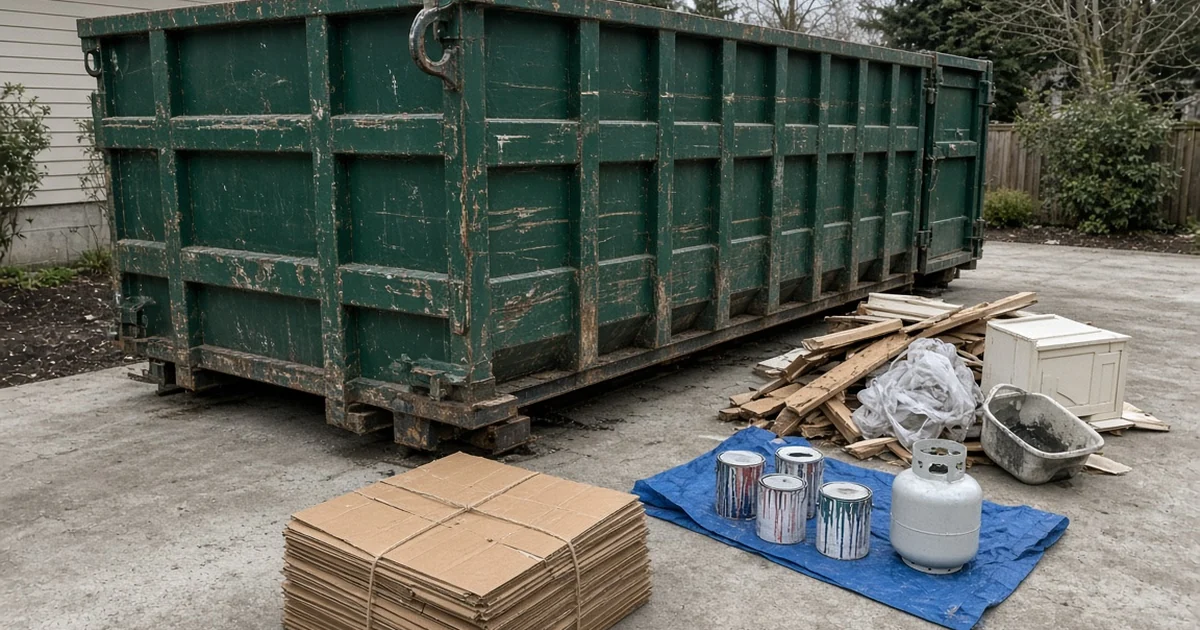
Metro Vancouver inspects garbage at Metro Vancouver and City of Vancouver solid waste facilities and adds a surcharge when banned materials are found in the load. The current rules are set out in the Disposal Ban Program Manual 2026 and in Tipping Fee Bylaw 400, which took effect on 1 July 2026. The fees and surcharges below are charged by Metro Vancouver at those facilities. They are not Trash King prices.
Banned recyclable materials
The Disposal Ban Program Manual 2026 lists these banned recyclable materials:
- Beverage containers, all except milk product containers.
- Containers made of glass, metal, recyclable plastic or composite materials. The Disposal Ban Program page also names recyclable plastic types 1, 2, 4 and 5.
- Corrugated cardboard.
- Recyclable paper.
- Yard trimmings.
- Food waste.
- Clean wood.
- Expanded polystyrene packaging.
The Disposal Ban Program page also lists auto parts and bodies under banned recyclable materials. The manual lists automobile bodies and parts under banned hazardous and operational impact materials instead.
Surcharges for banned recyclables
The Disposal Ban Program Manual 2026 sets a threshold for banned recyclable materials other than food waste and expanded polystyrene packaging. A load is surcharged when those materials make up 5% or more of the load by weight or volume. That 5% rule applies to one material or to a combination of those recyclable materials. Food waste and expanded polystyrene packaging are left out of that combined 5% calculation.
The surcharge is 50% of the tipping fee on the load.
Food waste has its own rule. The manual says the 50% surcharge applies when food waste makes up 25% or more of the load by weight or volume. Bylaw 400 describes this as a load that exceeds 25% by weight or volume.
Expanded polystyrene packaging has a higher surcharge. The manual says a load is surcharged at 100% of the tipping fee when that packaging makes up 20% or more of the load by weight or volume. The Disposal Ban Program page says the 100% surcharge applies to loads containing over 20% expanded polystyrene packaging. Bylaw 400 describes this as a load that exceeds 20% by weight or volume.
When more than one banned material is present, the manual says the inspector issues the surcharge for the material with the highest fee.
Banned hazardous, operational impact and product stewardship materials
These materials are surcharged if a single item is found in the garbage load. There is no percentage threshold.
The Disposal Ban Program Manual 2026 lists these banned hazardous and operational impact materials, among others:
- Agricultural waste.
- Automobile bodies and parts.
- Refuse that is on fire, smoldering, dusty, flammable or explosive.
- Hazardous waste as defined in the Hazardous Waste Regulation.
- Propane tanks.
- Liquids and sludge.
- Wire, hosing, rope and cable over 1 metre in length.
- Dead animals.
- Inert fill material, including soil, sod, gravel, concrete and asphalt, exceeding 0.5 cubic metres per load.
- Liquid containers 205 L or bigger.
- Single objects over 100 kg, 2.5 metres long or 1.2 metres wide. At the Waste-to-Energy Facility, a single object must not exceed 1.0 metre in length.
- Gypsum.
- Mattresses.
- Railroad ties or creosote treated wood.
- Toxic plants: giant hogweed, daphne also called spurge laurel, and devil’s club.
The Disposal Ban Program page also lists asbestos, biomedical waste, flammable materials, and containers bigger than 205 L in this group.
The manual lists these banned product stewardship materials:
- Solvents and flammable liquids.
- Pesticides.
- Gasoline.
- Pharmaceutical products and medications.
- Oil, oil filters and oil containers.
- Lubricating oils and lubricating oil containers.
- Paint and paint containers.
- Lead acid batteries.
- Antifreeze and containers.
- Electronic and electrical products, including metal household or commercial appliances identified in Schedule 3 of the Recycling Regulation.
- Tires.
The Disposal Ban Program page also lists batteries, fluorescent lights, thermostats, and electronic and electrical products including metal household or commercial appliances.
The $80 minimum surcharge
The Disposal Ban Program page says an $80 minimum surcharge applies to these loads. It covers loads that contain banned hazardous and operational impact materials or product stewardship materials. Possible costs of removal, cleanup or remediation can be added. Bylaw 400 sets this at $80 per load plus any remediation or cleanup costs. The manual says customers may also have to pay those costs, depending on the material.
Facility fees from 1 July 2026
Metro Vancouver published these facility fees for 1 July 2026 in its 2026 Garbage and Recycling Fees sheet. These are facility fees. They are not Trash King prices.
| Type of load | Metro Vancouver facility fee from 1 July 2026 |
|---|---|
| Garbage under 1 tonne | $182 per tonne, up to a maximum of $167 per load |
| Garbage from 1 to 7.99 tonnes | $162 per tonne, up to a maximum of $1,093 per load |
| Garbage of 8 tonnes or more | $136 per tonne, at facilities that accept these loads |
| Used gypsum | $210 per tonne, with a $15 minimum per load, including the $5 transaction fee |
| New gypsum | $158 per tonne, with a $15 minimum per load, including the $5 transaction fee |
| Yard trimmings and clean wood | $139 per tonne, with a $10 minimum |
| Mattresses and box springs | $20 each, maximum 4 units |
| Transaction fee | $5 per load of solid waste or gypsum |
The same fee sheet says the Tipping Fee Bylaw prevails if the sheet and the bylaw differ. Bylaw 400 lists a maximum of $162 per load for garbage under 1 tonne, and a maximum of $1,088 per load for garbage from 1 to 7.99 tonnes. It also lists a $5 transaction fee on each load of solid waste or gypsum. The fee sheet states that minimum and maximum fees include the transaction fee where applicable, which is how it arrives at the $167 and $1,093 maxima above.
Bylaw 400 sets a $10 minimum recycling fee for gypsum, yard trimmings and clean wood. Each gypsum load also pays the $5 transaction fee, so the fee sheet shows a $15 minimum per gypsum load. Yard trimmings and clean wood show a $10 minimum. Bylaw 400 sets these gypsum rates for loads of less than half a tonne. For a larger gypsum load, check with the centre before you go. It lists the $136 per tonne rate for loads of 8 tonnes or more at some facilities. It lists those loads as not accepted at the Central Surrey, Maple Ridge and Langley Recycling and Waste Centres.
If you take a load to a Recycling and Waste Centre yourself, check that centre’s current intake limits before you go. Some centres publish extra limits, such as a cap on used gypsum. Those extra limits can differ by centre, so check the centre you plan to use.
Recycling and Waste Centre rules
Metro Vancouver and the City of Vancouver run a network of recycling and waste centres and related solid waste facilities. Loads of garbage at those facilities can be inspected for banned materials.
The Maple Ridge Recycling and Waste Centre page publishes the same surcharge rules as the Disposal Ban Program. It lists an $80 minimum surcharge for banned hazardous, operational impact or product stewardship materials. It lists a 50% tipping fee surcharge for banned recyclable materials. It lists a 100% tipping fee surcharge for loads containing over 20% expanded polystyrene packaging.
Bylaw 400 and that centre page also set a surcharge for unsecured loads. The surcharge is 50% of the applicable tipping fee, up to $50.
Questions about a disposal ban surcharge can be emailed to disposal.bans@metrovancouver.org. For recycling drop off locations, Metro Vancouver points people to metrovancouverrecycles.org.
Trash King does not name a facility as the destination for your bin.
Drywall date stamps and testing
Gypsum is banned from garbage at Metro Vancouver facilities, as set out above. The date stamp and test steps below are New West Gypsum Recycling’s rule. They are not Metro Vancouver’s disposal ban list.
New West Gypsum Recycling splits loads into two groups: board dated 1990 and after, plus cut ends, and board dated before 1990 or without a date stamp.
A date stamp is a printed mark that is black, blue or purple. Acceptable date stamps are never green. The stamp can be on the front, back or edge of the board.
Loads dated 1990 or later, and cut ends, can be accepted when the load is consistent throughout and a Declaration and Acknowledgment form is completed.
Loads dated before 1990, or loads without a manufacturer’s date stamp, need a lab report that finds no asbestos, plus the required declaration and paperwork. Homeowners and contractors have different paperwork lists on the New West Gypsum British Columbia page.
A load that does not meet the rule can be rejected.
Drywall goes in its own Trash King 8 yard or 12 yard bin. Call for price. Asbestos never goes in any Trash King bin. See our drywall testing guide for the full steps.
What this means for your bin
You load the bin. Trash King delivers it and picks it up.
Sort banned recyclables out of mixed waste and keep them in their own bin or recycling stream. Drywall, concrete and dirt each go in their own 8 yard or 12 yard bin. Call for price. Do not put those heavy materials in a 20 yard or larger mixed waste bin.
The Metro Vancouver column below lists facility rules and facility fees. They are not Trash King prices. Trash King extras below are plus GST.
| Material | What Metro Vancouver does | What to do with a Trash King bin | Material page |
|---|---|---|---|
| Corrugated cardboard and recyclable paper | These are banned recyclables. The 50% tipping fee surcharge applies at 5% or more of a load, alone or combined with other banned recyclables. Food waste and expanded polystyrene packaging are left out of that combination. | Flatten cardboard and keep it out of mixed waste. A large pile of boxes can trip the 5% rule on its own. | /cardboard-recycling/ |
| Clean wood | Clean wood is a banned recyclable under the same 5% rule. From 1 July 2026, Metro Vancouver lists a facility fee of $139 per tonne for a sorted clean wood load, with a $10 minimum. | Keep untreated, unpainted clean wood out of mixed waste. Ask about a separate wood bin when you book. | /wood/ |
| Yard trimmings | Yard trimmings are a banned recyclable under the same 5% rule, with the same $139 per tonne facility fee and $10 minimum from 1 July 2026. Toxic plants (giant hogweed, daphne also called spurge laurel, and devil’s club) are banned hazardous materials. One plant can trigger the $80 minimum surcharge. | Keep yard trimmings out of mixed waste. The toxic plants named here stay out of every Trash King bin. | /yard-waste-bin-rental-greater-vancouver/ |
| Food waste | The manual applies a 50% tipping fee surcharge when food waste makes up 25% or more of the load. | Keep food waste out of the mixed waste bin. | /materials-we-recycle/ |
| Expanded polystyrene packaging | The manual applies a 100% tipping fee surcharge when this packaging makes up 20% or more of the load. The program page says over 20%. | Keep foam packaging out of the mixed waste bin. | /materials-we-recycle/ |
| Beverage containers and other recyclable containers | These are banned recyclables under the 5% rule. The program page names recyclable plastic types 1, 2, 4 and 5. | Keep them out of mixed waste and recycle them. | /materials-we-recycle/ |
| Drywall (gypsum) | Gypsum is a banned hazardous and operational impact material. One piece in garbage can trigger the $80 minimum surcharge plus cleanup costs. From 1 July 2026, the fee sheet lists used gypsum at $210 per tonne and new gypsum at $158 per tonne, with a $15 minimum per load, including the $5 transaction fee. | Drywall goes in its own 8 yard or 12 yard bin. Call for price. Check the date stamp and test rule in the section above. Asbestos never goes in any Trash King bin. | /drywall/ |
| Concrete | Inert fill such as soil, sod, gravel, concrete and asphalt exceeding 0.5 cubic metres per load is a banned hazardous and operational impact material. | Concrete goes in its own 8 yard or 12 yard bin. Call for price. Do not mix it into a 20 yard or larger mixed waste bin. | /concrete/ |
| Dirt and clean fill | The same inert fill rule applies to soil and similar fill over 0.5 cubic metres in a garbage load. | Dirt and clean fill go in their own 8 yard or 12 yard bin, one material per bin. Call for price. Do not mix them into a 20 yard or larger mixed waste bin. | /dirt/ |
| Mattresses and box springs | Mattresses are on the single item ban list for garbage. The fee sheet lists a facility fee of $20 each for mattresses and box springs, with a maximum of 4 units. | They can go in a mixed waste bin as a Trash King extra at $75 each plus GST. Tell us the count when you book. | /household-garbage/ |
| Tires | Tires are a banned product stewardship material. One tire in garbage can trigger the $80 minimum surcharge. | Trash King charges $75 plus GST for each tire as an extra. Tell us the count when you book. | /household-garbage/ |
| Paint, chemicals, liquids, TVs and other electronics | These sit on the product stewardship or hazardous lists. One item in garbage can trigger the $80 minimum surcharge plus cleanup costs. | These stay out of every Trash King bin. | /household-garbage/ |
| Creosote treated wood and railroad ties | These are banned hazardous and operational impact materials. One item can trigger the $80 minimum surcharge. | These stay out of every Trash King bin. | /wood/ |
| Asbestos and hazardous waste | The Disposal Ban Program page lists asbestos and hazardous waste in the banned hazardous group. One item can trigger the $80 minimum surcharge plus cleanup costs. | Asbestos and hazardous waste never go in any Trash King bin. | /testing-drywall-before-disposal-in-metro-vancouver-date-stamps-lab-reports-and-where-it-goes/ |
If you have questions about what can go in your bin, call 604-433-5865 or email quotes@trashking.ca.
FAQs
What is the Metro Vancouver disposal ban surcharge?
Metro Vancouver adds a surcharge when banned materials are found in a garbage load at its facilities and at City of Vancouver solid waste facilities. Banned recyclables over the threshold bring a surcharge of 50% of the tipping fee. Hazardous, operational impact and product stewardship items bring an $80 minimum surcharge plus any cleanup costs.
When does the 50% recyclable surcharge apply?
The Disposal Ban Program Manual 2026 sets the 50% surcharge for banned recyclable materials other than food waste and expanded polystyrene packaging. It applies when those materials make up 5% or more of the load by weight or volume. Food waste has a higher threshold of 25% or more.
What surcharge applies to foam packaging?
The manual says Metro Vancouver charges a 100% tipping fee surcharge for expanded polystyrene packaging at 20% or more of the load by weight or volume. The Disposal Ban Program page describes this as a load containing over 20% expanded polystyrene packaging.
Are Metro Vancouver tipping fees the same as Trash King prices?
No. Metro Vancouver tipping fees and surcharges are facility fees charged at regional disposal sites. Trash King bin prices are separate and are quoted plus GST.
Is drywall banned in Metro Vancouver?
Gypsum is banned from garbage at Metro Vancouver facilities, and one piece in a garbage load can trigger the $80 minimum surcharge. Drywall goes in its own Trash King 8 yard or 12 yard bin. Call 604-433-5865 for the price.
What should stay out of a Trash King bin?
Keep asbestos, hazardous waste, chemicals, paint, TVs and other electronics, freon appliances and liquids out of every Trash King bin. Creosote treated wood, railroad ties, giant hogweed, daphne also called spurge laurel, and devil’s club also stay out.
What do I do with drywall dated before 1990?
New West Gypsum Recycling requires a lab report showing no asbestos, plus the required declaration, for board dated before 1990 or board with no date stamp. This is New West Gypsum’s rule, not Metro Vancouver’s ban list. Asbestos never goes in any Trash King bin.