
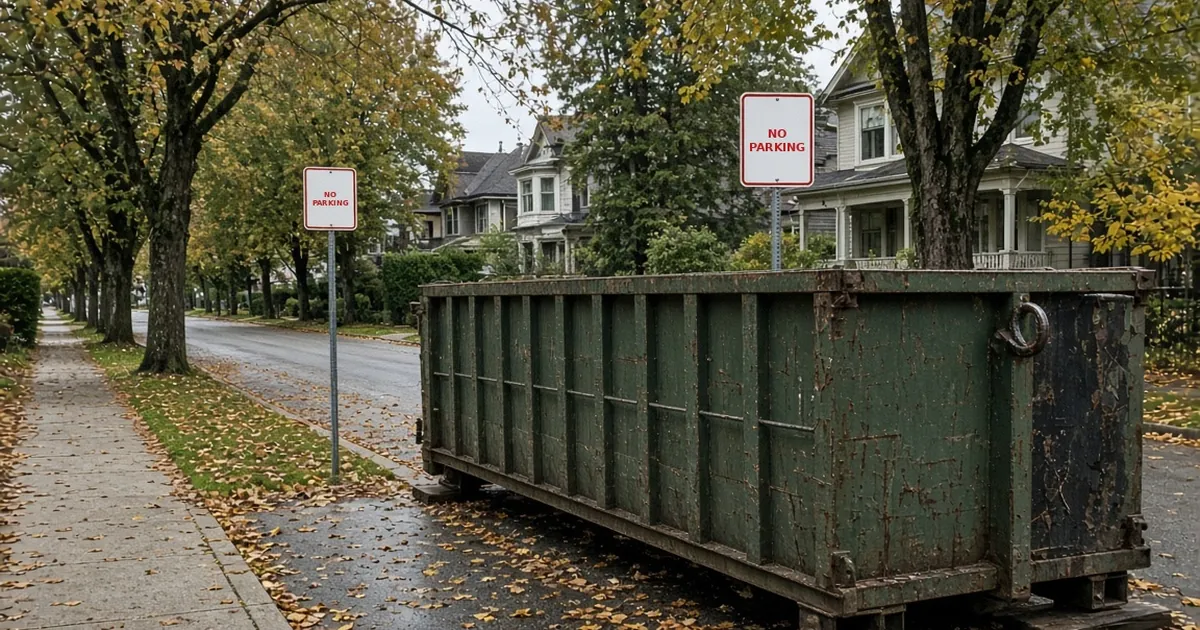
If your driveway can’t take a bin, the curb lane in front of your home can work in the City of Vancouver. You need the City’s permission first. It comes as a temporary street occupancy permit, and the City currently asks for at least 7 to 10 business days from the time you pay. Rules and timelines change often, so check with the City before you plan your dates.
The short version: apply for the permit online, pay at least 10 business days before bin day, then book the bin for your permit dates. You load the bin. We deliver it and haul it away. The street permit is yours to arrange, and we schedule the drop around your permit dates.
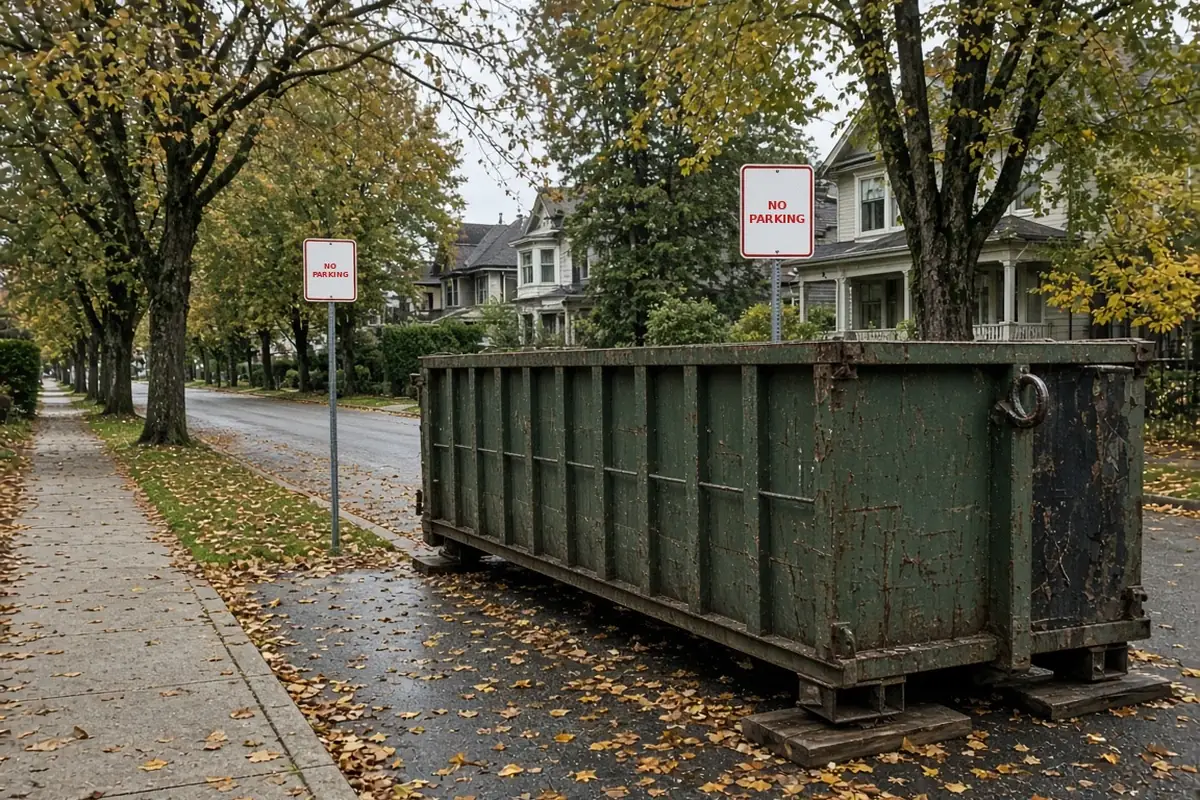
When a street permit comes into play
The City’s temporary street occupancy permit covers waste containers and bins. The same permit is used for moving trucks, storage containers and construction deliveries. The City’s page splits bin placement into three cases.
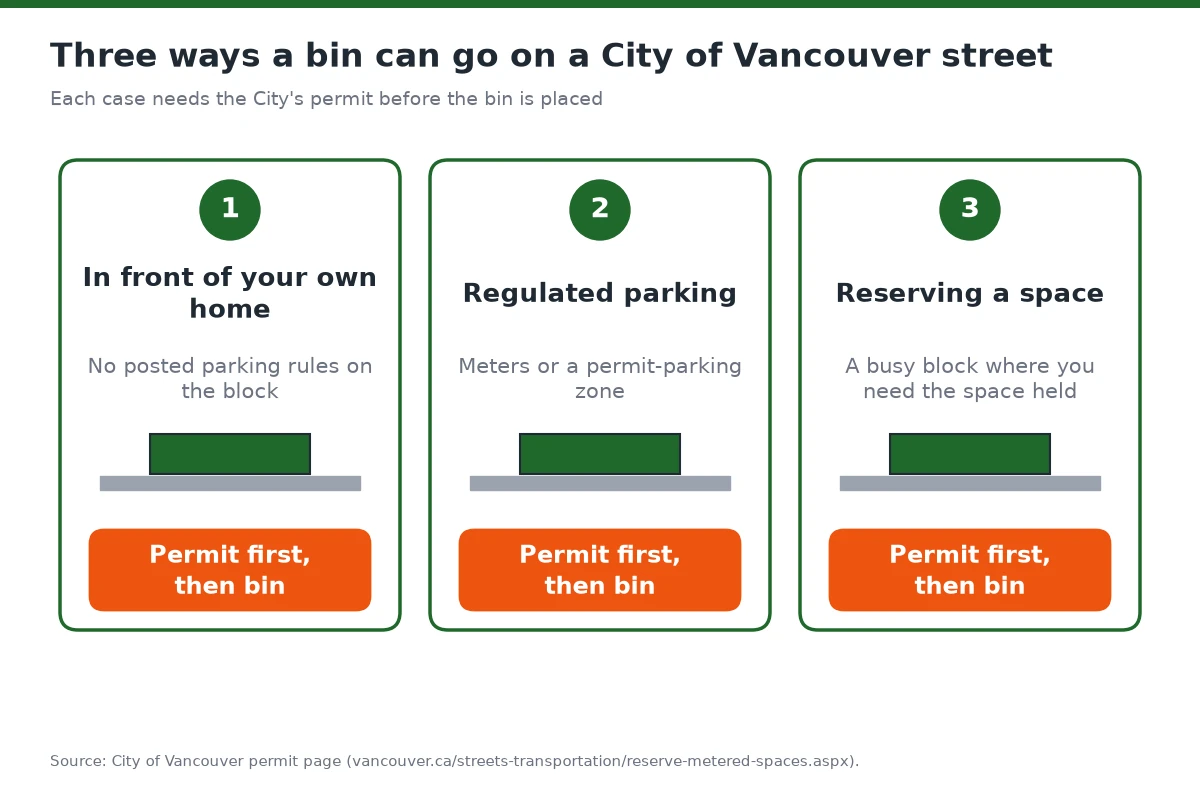
A bin in front of your own home with no posted parking rules
The City says you can request permission for up to 2 days without a fee. You still have to receive the permit before the bin is placed.
A bin where parking is regulated
Meters, time limits and permit-parking zones all count as parking regulations. To place a bin there, the City temporarily suspends those rules, and additional fees generally apply. If the bin sits on the street or in a special zone, staff may also prepare a street occupancy permit to go with it.
Holding a space when parking is tight
On a busy block you can buy a permit to reserve the space. The City says no fee is charged for the bin placement itself if street use is no more than 2 days.
In all three cases the permit comes first and the bin comes second.
Check the driveway one more time
Before you apply, measure your driveway and the approach. A private pad keeps the job simpler. Our driveway vs street placement guide covers grade, overhead wires and truck approach.
If the street really is the only option, think about how much of it you need. The City treats the curb lane differently from a rear lane, a sidewalk, a bike lane or a travel lane. Lane use fees apply to rear lanes (alleys), sidewalk closures, bike lanes and traffic lanes. If you need more than the curb lane, contact Engineering Services before you apply.
What to gather before you apply
The application asks for details you can collect on the sidewalk with your phone.
- Location. The address or hundred block where you want the bin.
- Parking rules at that spot. Note any time limits, permit zones or special zones.
- Meter numbers. If there are meters, write down the 6-digit meter ID. The City is clear that it wants the 6-digit number, not the 5-digit pay-by-phone number.
- How much street you need. Parking lane only, or more.
- Dates and times. When the bin arrives, how long it stays, and when it leaves.
- What the work is. A short description such as “roll-off bin for a kitchen renovation.”
- Insurance, if it applies to you. Businesses and contractors must provide a liability insurance certificate that names the City of Vancouver. The City exempts residents moving in or out of an address. If you’re a homeowner running your own reno, ask the City whether a certificate applies to your application.
Some uses of public property also need a traffic management plan. Closing a sidewalk, bike lane or travel lane is the usual trigger.
How to get a Vancouver bin street permit, step by step
- Review the bin requirements on the City’s temporary street occupancy permit page.
- Gather the details above.
- Apply online by registering for an account in the City’s permit portal. You can also email engineering.clientservices@vancouver.ca to book an in-person appointment. The City says simple applications are generally approved right away.
- Pay for the permit. As of October 2026, the City lists a no-parking signage fee of $138.46 for each 7-day period, or a one-time $138.46 plus meter rates where there are meters or pay stations. A bin stored on City property also carries an occupancy fee of $3.99 per 10 square metres per day, with a $135.14 minimum. Fees are set by the Street and Traffic By-law 2849, Schedule I. The 7 to 10 business day clock starts when your payment is received.
- Watch for the signs. A City crew installs the parking signs 1 to 2 business days before your start date. Keep a copy of the permit with you. If you don’t see signs the day before, email Engineering Client Services.
Work back from bin day
Count business days, not calendar days, and leave room for a statutory holiday.
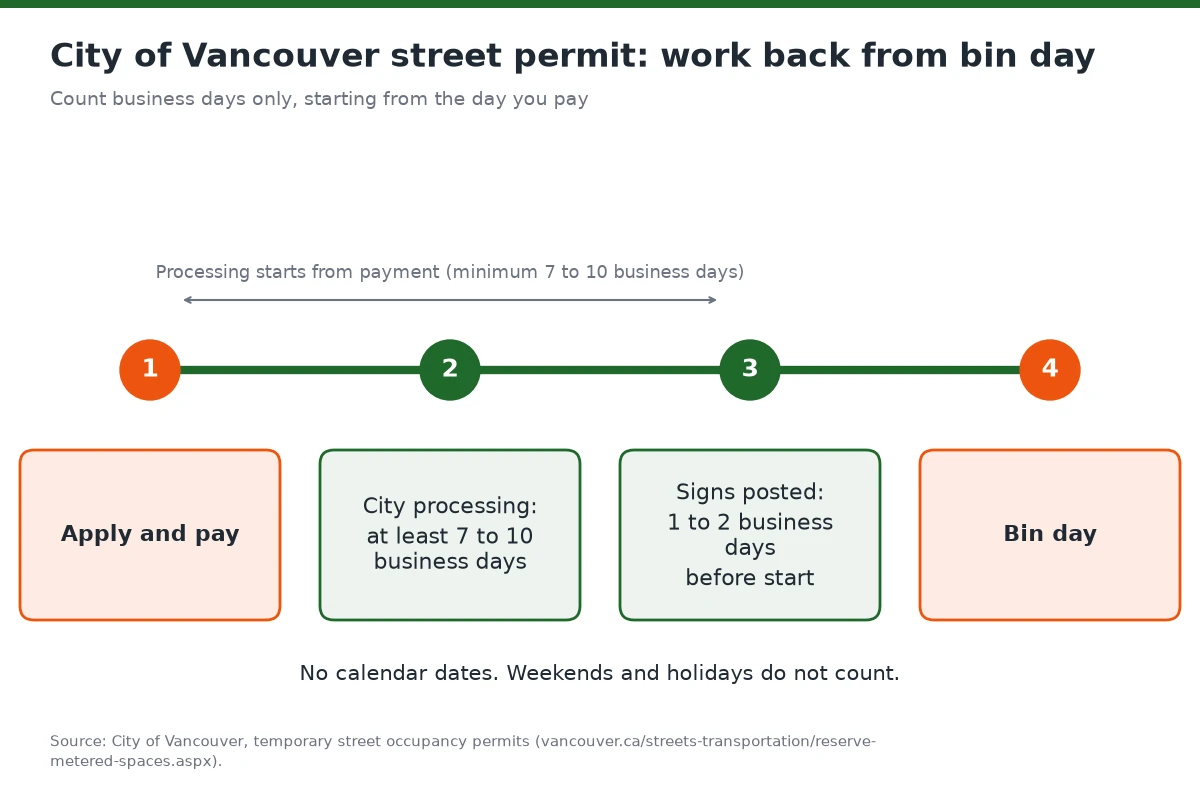
A simple plan looks like this:
- Pick your bin day. Choose the morning you want to start loading.
- Count back at least 10 business days. That’s your latest safe date to apply and pay.
- Book the bin. Once the permit dates are set, call us at 604-433-5865 or email quotes@trashking.ca with the address, the permit dates and what you’re loading.
- Signs go up. Expect them 1 to 2 business days before the permit start.
- Bin day. We drop the bin in the permitted space. You load it. Call us when it’s ready to go.
Short on time? The City says that if you only have 5 to 7 business days, you can email engineering.clientservices@vancouver.ca and staff will assess whether the request can be done in time. Contacting them doesn’t guarantee approval, so treat this as a backup plan.
What happens on bin day
The permit doesn’t let you move a car that was parked legally before the signs went up. If a vehicle is in your reserved space, phone 3-1-1 with the licence plate. The City says it will be towed only if it wasn’t recorded as being there when the signs were installed. The City also doesn’t refund a permit if a car was there before the signs, or if the signs were stolen.
That’s a good reason to ask for permit dates that start a day before your bin delivery. You get a morning to see that the space is clear. For the rest of delivery-day prep, see our step-by-step prep checklist.
Loading a bin on the street
A street bin is in public view all day, so a tidy load matters more.
- Keep everything inside the rim. A bin loaded past the rim has to be fixed before we can haul it.
- Keep the sidewalk and the boulevard clear.
- Stack heavy, flat pieces first and fill gaps with bagged debris. Our loading guide has the details.
- Keep paint, propane tanks, fuel and tires out of the bin. Our list of what not to put in a disposal bin shows where those go instead.
If your application is turned down
If an application is rejected, the City’s automated email includes a comment. Two reasons come up most. The request needs a Traffic Control Plan, usually because it closes a sidewalk, travel lane or bike lane. Or there isn’t enough lead time. If the reason isn’t clear, email engineering.clientservices@vancouver.ca.
Outside the City of Vancouver
Every municipality runs its own process, and the permit names differ. If the bin is going to Burnaby, Surrey, Richmond or another city we serve, start with that city’s page on our Metro Vancouver bin rental page, then confirm with the city itself.
FAQ
How far ahead should I apply for a Vancouver street permit for a bin?
The City currently asks for a minimum of 7 to 10 business days from the time your payment is received. Rules and timelines change often, so check with the City first. That window allows for posting signs and covering meters.
Will Trash King apply for the permit?
You apply for the permit yourself. Send us your permit dates and we’ll book delivery and pickup to match.
Is there a fee?
Usually, yes. For a bin in front of your own home with no posted parking rules, the City says it doesn’t charge a fee for up to 2 days, though you still need the permit first. Metered or regulated spots carry fees. As of October 2026, the City lists $138.46 for each 7 days of no-parking signage and a $135.14 minimum occupancy fee for a bin on City property.
Can the bin go in the lane behind my house?
Rear lanes are public property and lane use fees apply. Contact the City’s Engineering Services before you plan a lane drop.
What if someone parks in my permitted space?
Phone 3-1-1 with the licence plate. If the car wasn’t recorded there when the signs went up, the City will have it towed.
Sources
- City of Vancouver, Reserve parking spaces and parking meters with temporary street occupancy permits (lead time, three bin cases, insurance, steps, signage timing, 3-1-1, rejections, fees by-law, 2026 signage and occupancy fees): https://vancouver.ca/streets-transportation/reserve-metered-spaces.aspx (checked 2026-10-29)
- City of Vancouver, Street and Traffic By-law 2849 (section 30, Schedule I), linked from the page above.
- Trash King pages: https://trashking.ca/greater-vancouver/ and https://trashking.ca/driveway-vs-street-bin-placement-metro-vancouver/ (checked 2026-10-29)