
Attics collect decades of boxes, old decorations and furniture that never came back down. Clearing one out is a satisfying weekend job. Before you start passing boxes down the ladder, take ten minutes to look at what the boxes are sitting on and what’s been living around them.
Check a few things first, then deal with what you find and plan the bin for everything that comes down.
Look at the insulation before you touch anything
Shine a light across the attic floor before you step in. The insulation tells you how to proceed.
Loose-fill insulation
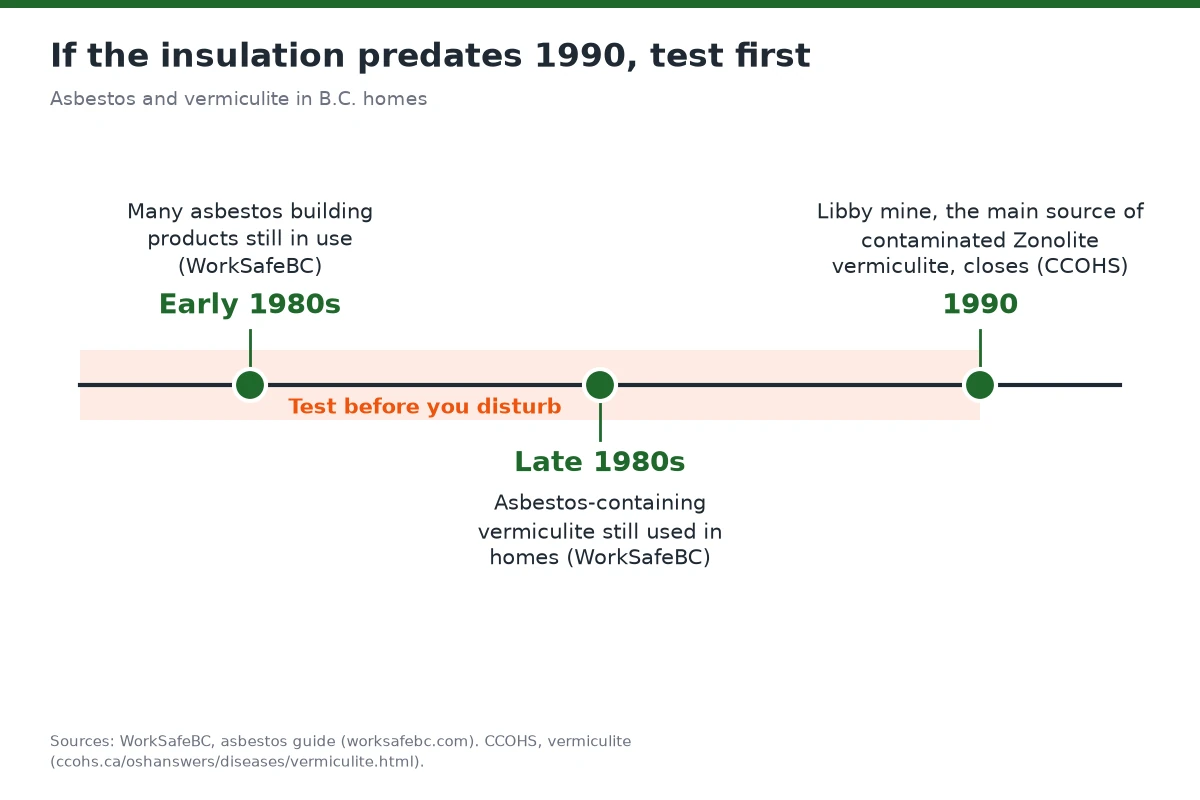
The Canadian Centre for Occupational Health and Safety describes vermiculite as a silver-gold to grey-brown mineral. As attic insulation it’s a loose fill. Health Canada says vermiculite insulation may contain asbestos. WorkSafeBC lists loose, blown-in insulation such as vermiculite among possible asbestos sources in older homes and says asbestos-containing vermiculite was used in homes up until the late 1980s.
Not all vermiculite contains asbestos. You can’t tell by looking, though, and CCOHS recommends testing before any work.
Batts, blown fibre and everything else
Other insulation types include fibreglass batts and blown fibre. An attic can have more than one layer. If you can’t identify every layer, treat it as unknown and get it checked before you disturb it.
WorkSafeBC’s homeowner pamphlet also lists incandescent light fixture backing and recessed lighting among possible asbestos sources. Leave old fixtures in place for now.
If you find vermiculite, stop and test
Health Canada’s advice for vermiculite in an attic:
- Don’t use the attic for storage.
- Keep children out of the attic.
- Don’t disturb the insulation or try to remove it yourself.
- Seal gaps around the attic hatch, light fixtures and outlets.
- Hire professionals trained to handle asbestos if you plan to renovate.
That leaves a practical question. What about the boxes already sitting up there? Moving them can stir up the fill underneath. Ask the professional who does the testing how to get stored items out safely. Don’t sweep or vacuum around them in the meantime.
Asbestos-containing insulation never goes in a rental bin. If testing comes back positive, a licensed asbestos abatement contractor removes and disposes of it.
Check for droppings and nests
Attics are popular with mice. HealthLink BC notes that deer mice live throughout B.C. and like spaces such as attics. Hantavirus spreads when dust from old droppings and urine is stirred up and breathed in.
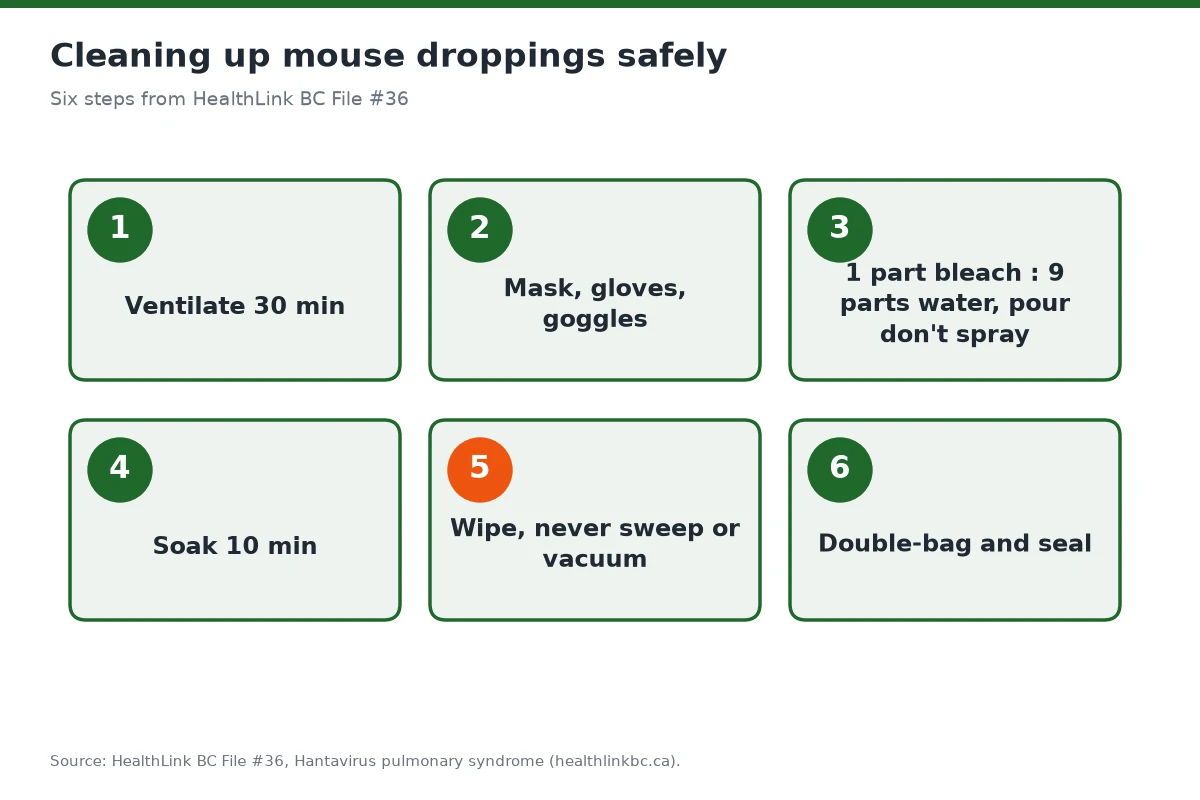
If you see droppings, nests or chewed material, HealthLink BC’s cleanup steps are:
- Ventilate the space for 30 minutes before you start.
- Wear rubber gloves, goggles and a well-fitting N95 mask or a respirator with P100 filters. A painting dust mask isn’t the same thing.
- Pour disinfectant carefully onto the droppings. Diluted bleach works at 1 part bleach to 9 parts water. Don’t use a sprayer. Let it soak for 10 minutes.
- Wipe it up with paper towels. Don’t sweep and don’t vacuum.
- Double-bag the waste, seal the bags and put them in the trash as local bylaws allow.
- Wash your gloves before you take them off, then wash your hands.
For a heavy infestation, the Public Health Agency of Canada suggests hiring a professional cleaning company.
Make the attic safe to work in
A few basics keep the job steady:
- Bring good portable lighting and keep the cord clear of the hatch.
- Step only on joists or on boards laid across them. The ceiling below won’t hold your weight.
- Work early in the day in summer. Attics get hot fast.
- Keep one person at the bottom of the ladder to take boxes, and keep three points of contact as you climb.
Sort everything as it comes down
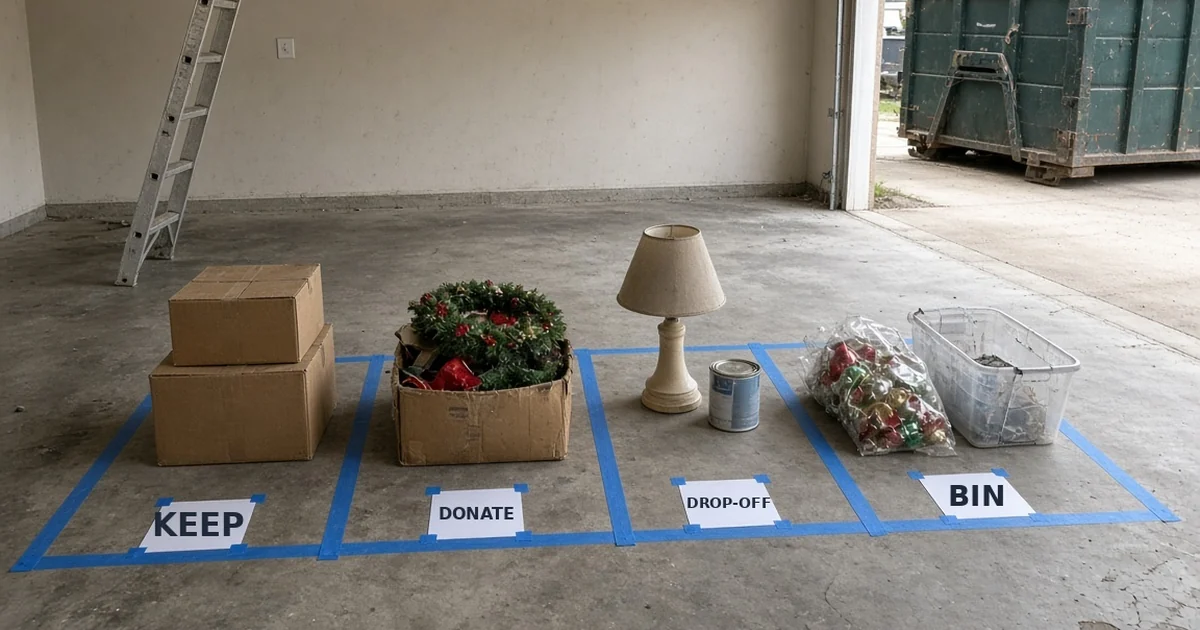
Set up a sorting area in the garage or a spare room before the first box arrives. Four piles work well: keep, donate or sell, drop-off items and bin.
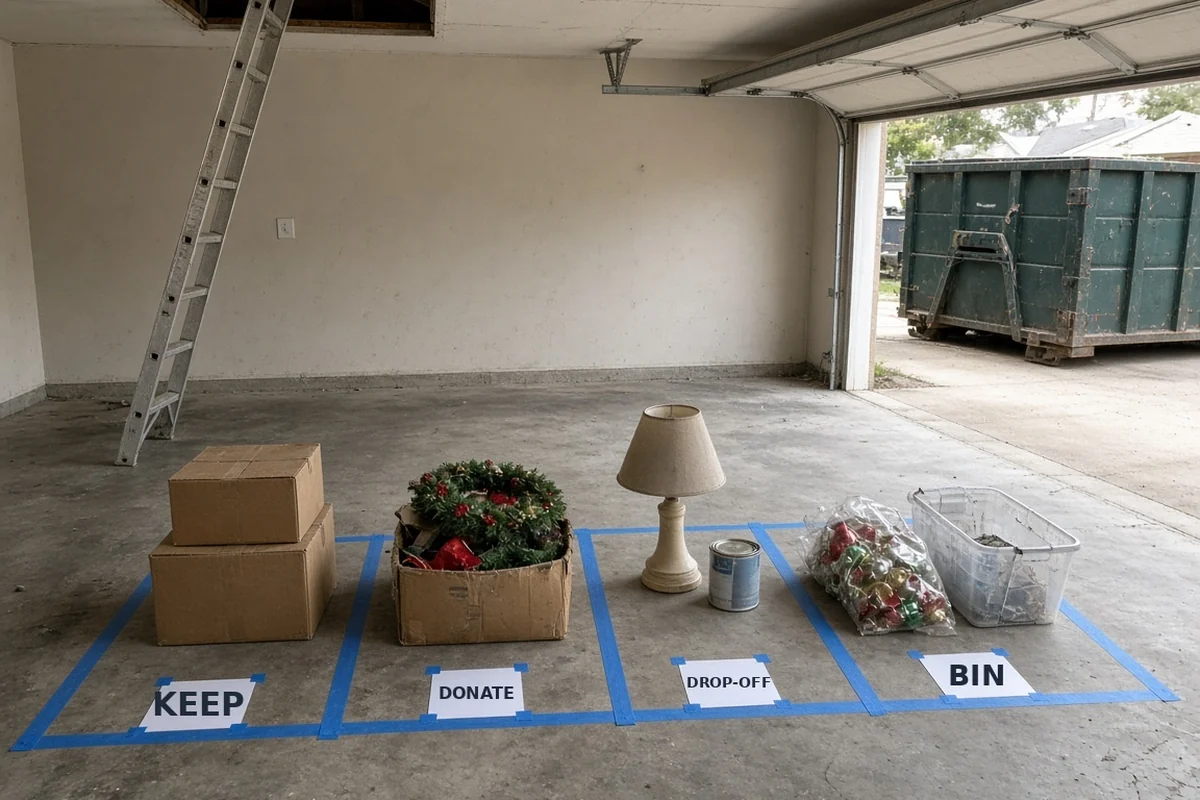
Some attic finds belong at a drop-off, not in a bin:
- Paint and spray-paint cans: take them to a Product Care paint depot or most Metro Vancouver recycling and waste centres, such as United Boulevard.
- Batteries and old electronics: free drop-off at most Metro Vancouver recycling and waste centres, such as United Boulevard. Return-It sites take electronics too.
- Small propane or camping fuel canisters: most Metro Vancouver recycling and waste centres, such as United Boulevard. Never put them in the bin.
For everything else, check our list of what not to put in a Metro Vancouver disposal bin.
Old boxes, broken decorations, worn luggage, damaged furniture and general household clutter can go in the bin. Insulation that has tested clear of asbestos can go in the bin, but you may be asked to show the test results. Keep it bagged until it goes in. Our residential services page explains how we work with homeowners.
Pick the bin size and the spot
Attic loads are usually bulky and light. Our 15-yard bin page lists attic cleanups among the jobs it suits, at about 15 feet long, 8 feet wide and 5 feet tall. Sizes vary a little between bins. If the attic is part of a whole-house clear-out, tell us about the garage and basement too so the size covers all of it.
Place the bin on your driveway if you can. If any part of it will sit on the street, boulevard or lane, check with your City before delivery, since rules and timelines change often. Our pre-delivery homeowner checklist walks through placement and access.
Load it at your own pace. Our truck brings the bin and takes it away when you’re finished.
Ready to clear the attic? Call us at 604-433-5865 or email quotes@trashking.ca.
FAQ
What does vermiculite insulation look like?
CCOHS describes vermiculite as a silver-gold to grey-brown mineral. As insulation it’s a loose fill. If you think you have it, get it tested before you touch it.
Can I clear out boxes sitting on vermiculite?
Health Canada says not to disturb vermiculite insulation. Ask the professional who tests it how to remove stored items safely.
Can attic insulation go in the bin?
Asbestos-containing insulation never goes in a rental bin. Insulation that has tested clear can go in the bin, but you may be asked to show the test results. Keep it bagged until it goes in.
How do I clean up mouse droppings in the attic?
Follow HealthLink BC’s steps. Ventilate for 30 minutes, wear a proper mask, gloves and goggles, soak the droppings with disinfectant for 10 minutes, wipe them up and double-bag them. Never sweep or vacuum.
What size bin do I need for an attic cleanout?
Our 15-yard bin page lists attic cleanups among its uses. Tell us what else is coming out of the house so we can confirm the size.
Sources
- WorkSafeBC, Have your home tested for asbestos before reno, demo, or maintenance work (hire a licensed asbestos surveyor, then a licensed asbestos abatement contractor): https://www.worksafebc.com/en/about-us/news-events/campaigns/asbestos (checked 2026-10-30)
- Health Canada, Asbestos and your health (vermiculite may contain asbestos, don’t store in attic, keep children out, don’t disturb or remove, seal gaps, hire trained professionals): https://www.canada.ca/en/health-canada/services/air-quality/indoor-air-contaminants/health-risks-asbestos.html (checked 2026-10-30)
- CCOHS, Vermiculite Insulation Containing Asbestos (silver-gold to grey-brown, not all vermiculite contains asbestos, test before any work, Libby mine closed 1990): https://www.ccohs.ca/oshanswers/diseases/vermiculite.html (checked 2026-10-30)
- WorkSafeBC, Asbestos homeowner pamphlet (loose blown-in insulation such as vermiculite, light fixture backing, recessed lighting, asbestos products used until early 1980s, vermiculite until late 1980s): https://www.worksafebc.com/~/media/F9B18996A8E94660B81D8921487C0F35.ashx (checked 2026-10-30)
- HealthLink BC, Hantavirus Pulmonary Syndrome, File #36 (ventilate 30 minutes, mask types, 1:9 bleach, no sprayer, soak 10 minutes, don’t sweep or vacuum, double-bag): https://www.healthlinkbc.ca/healthlinkbc-files/hantavirus-pulmonary-syndrome (checked 2026-10-30)
- HealthLink BC, Cleaning a shed, attic, cabin or barn? Protect against hantavirus (deer mice throughout B.C., like attics): https://www.healthlinkbc.ca/node/53646 (checked 2026-10-30)
- Public Health Agency of Canada, Hantavirus prevention (professional cleaning for heavy infestations): https://www.canada.ca/en/public-health/services/diseases/hantaviruses/prevention-hantavirus-infection.html (checked 2026-10-30)
- Trash King, 15-yard bin (attic cleanups, 15 x 8 x 5 ft): https://trashking.ca/15-yard-bin/ (checked 2026-10-30)
- Trash King, What not to put in a Metro Vancouver disposal bin: https://trashking.ca/what-not-to-put-in-metro-vancouver-disposal-bin/ (checked 2026-10-30)
- Metro Vancouver, United Boulevard Recycling and Waste Centre (paint, electronics, batteries and propane tanks accepted free): https://metrovancouver.org/services/solid-waste/united-boulevard-recycling-and-waste-centre (checked 2026-10-30)
- Product Care Recycling, Household hazardous waste and paint in B.C.: https://www.productcare.org/products/hhw/british-columbia/ (checked 2026-10-30)
- Return-It Electronics, drop-off locations: https://www.return-it.ca/electronics/ (checked 2026-10-30)