
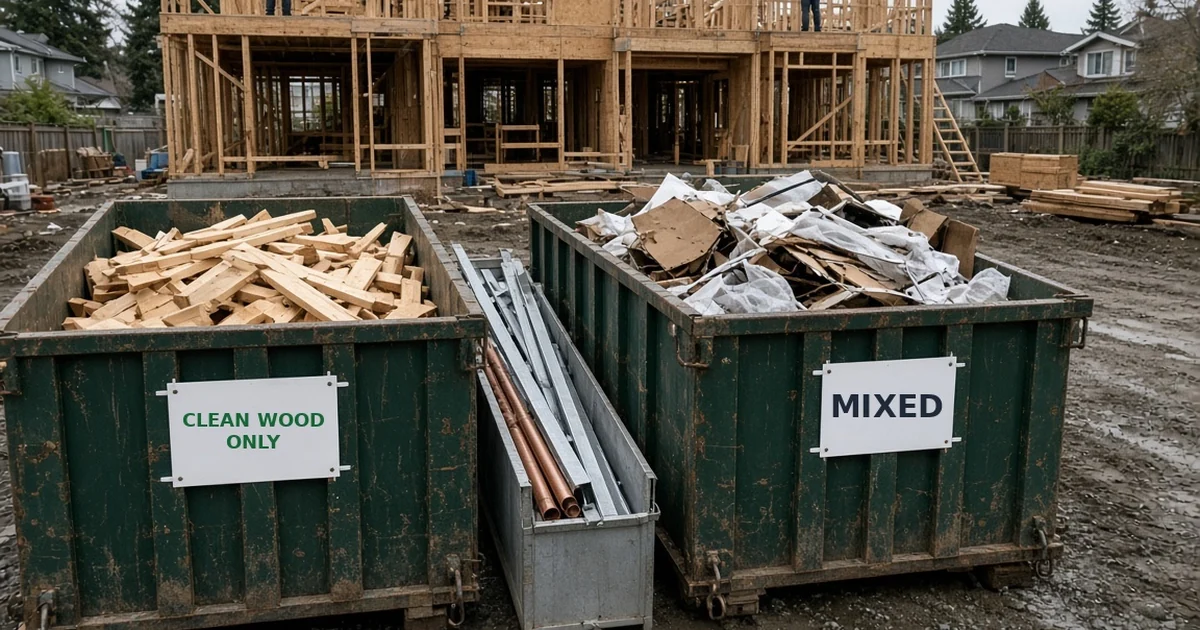
A single mixed bin is the easy default on a job site. It can also pick up a surcharge if banned recyclables make up more than 5% of a load by weight or volume, and it sends recyclable wood and metal to the same place as garbage. A simple sorting system keeps the big streams clean without slowing the crew down.
You’ll see what to separate, how to set it up and when one mixed bin is the better call. Your crew fills the bins. Trash King drops each one off and hauls it away when it’s full.
Why sorting pays on a Metro Vancouver site
The disposal ban rules
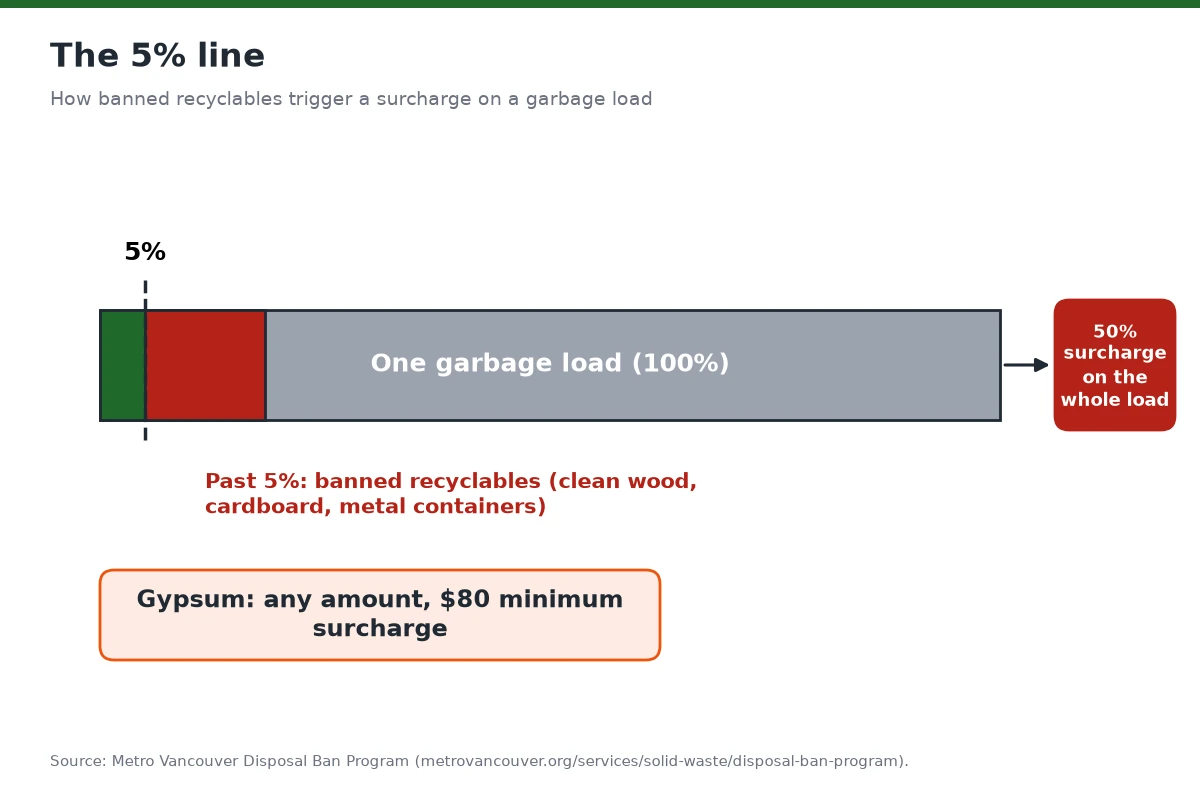
Metro Vancouver bans some materials from garbage. Clean wood, corrugated cardboard and metal containers are banned recyclables. A load is surcharged at 50% of the tipping fee on the entire load when banned recyclables make up more than 5% of a load by weight or volume. Gypsum is on the ban list too, and any amount can bring an $80 minimum surcharge.
The public rates
As of October 2026, Metro Vancouver’s public scale rates at the United Boulevard Recycling and Waste Centre in Coquitlam show why clean streams matter:
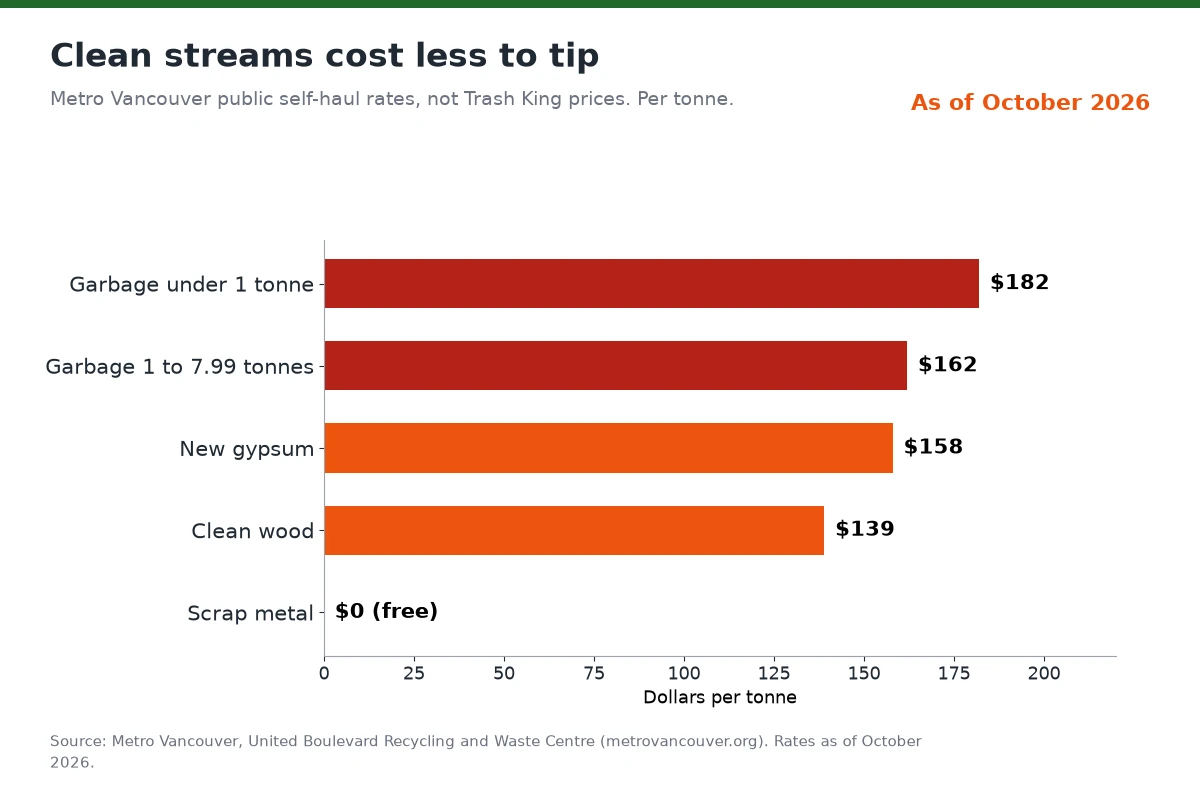
- Garbage: $182 per tonne under 1 tonne, $162 per tonne from 1 to 7.99 tonnes
- Clean wood: $139 per tonne
- Scrap metal: free
- New gypsum: $158 per tonne, with a signed declaration form
These are Metro Vancouver’s self-haul rates. Trash King’s prices are separate. At these rates, clean wood and scrap metal cost less to tip than garbage.
The three core streams
1. Clean wood
Metro Vancouver defines clean wood as unpainted, unstained and untreated, with no glues or resins. Nails are okay. A Trash King clean-wood bin takes unpainted wood only, with nails. Nothing else can go in it. On a build, that usually means:
- Dimensional lumber offcuts
- Untreated framing scrap
- Clean pallets and crating
What doesn’t count: pressure-treated lumber, painted or stained wood, and plywood, OSB or particle board made with glues and resins. Painted, stained and glued wood goes in the mixed stream. Keep treated wood out of clean-wood loads. Tell us about treated or painted wood when you book, since it needs special handling. Our wood page covers the differences.
2. Metal
Job-site metal can include:
- Steel studs and track
- Rebar offcuts
- Copper pipe and wire scraps
- Ductwork and flashing
Keep metal free of wood and garbage. See our metal recycling page and our post on scrap metal bins vs scrap yards.
3. Mixed waste
Everything else that’s allowed. Common mixed materials include painted wood, insulation offcuts, packaging film, broken fixtures and general site debris.
Other materials to plan separately
- Drywall: gypsum is banned from garbage. Drywall goes in its own separate bin. See our drywall page.
- Cardboard: flatten it and keep it out of the rain. Enough boxes can push a mixed load over the 5% limit on its own.
- Concrete and dirt: concrete goes in its own separate bin, and so does dirt. See our concrete page.
- Roofing: heavy and often its own phase. See our roofing tear-off page.
Paint, propane, fuel and tires never go in any bin. Leftover paint goes to a Product Care Recycling drop-off, propane tanks to a Metro Vancouver recycling and waste centre such as United Boulevard, and tires to a Tire Stewardship BC return site.
Setting up streams on a tight site
If your site doesn’t have room for three bins at once, you have options:
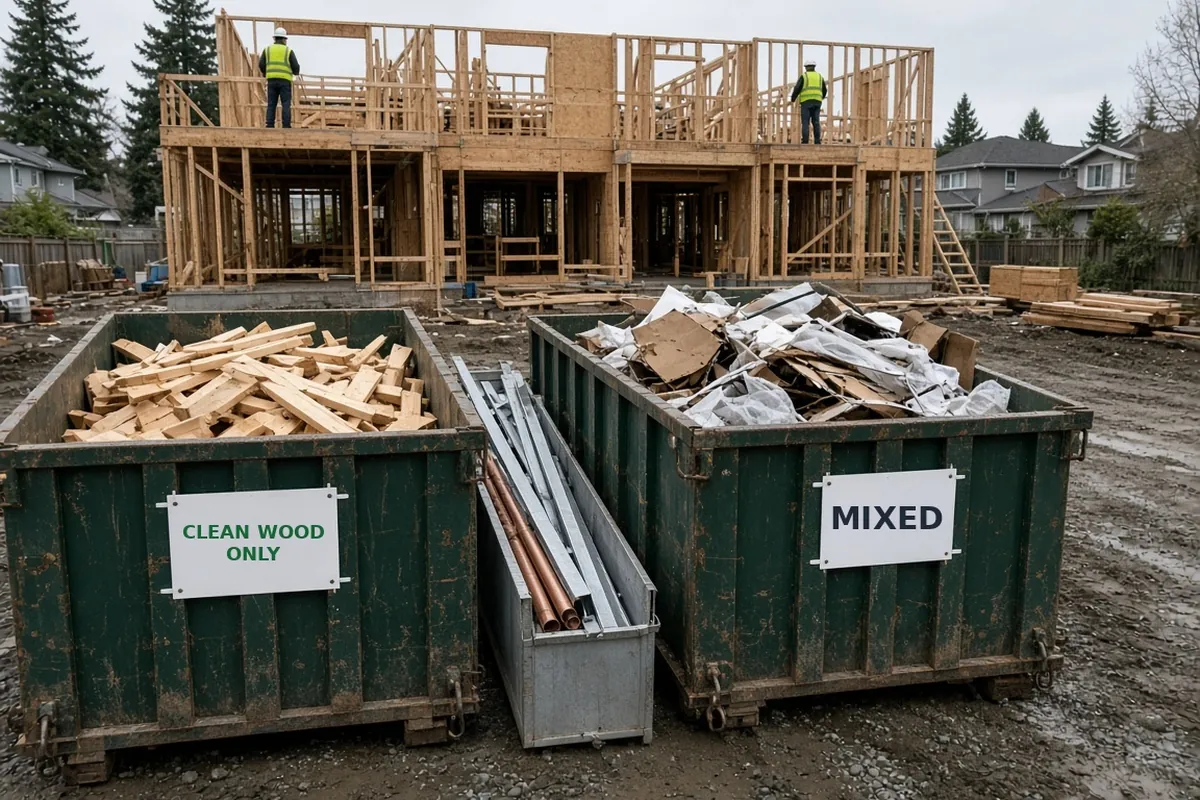
Separate bins side by side
Works on larger lots and sites with a lane or a big pad. Each bin gets a clear sign.
One bin per phase
Match the bin to what the phase produces. Our new construction waste page lists the pattern: early framing is wood-heavy, drywall and finishing bring packaging spikes, and the final clean is mostly packaging. A clean-wood bin during framing, then a mixed bin for finishing, with drywall in its own separate bin, keeps each load simple. Ask about swaps when you book.
Staged piles and one bin
Keep metal in a small marked pile or a tote and the clean wood stacked in a corner. Load the mixed bin daily. When the metal or wood pile is big enough, book a bin or a swap for that stream.
Leave a clear truck approach and swing path for every bin. Blocked sites delay swaps.
Keep each stream clean
A sorting system only works if the streams stay clean.
- Signs on every bin and pile. Big, simple labels: “Clean wood only”, “Metal only”, “Mixed”.
- Brief each trade. Tell new crews where each stream goes on their first day.
- One person checks daily. A quick look at the wood and metal bins catches contamination before it builds up.
- Pull mistakes right away. A bag of garbage or a painted board in the clean-wood bin is easy to fix the same day.
- Keep loads level. Nothing above the rim. Schedule a swap instead of mounding.
When one mixed bin is the right call
Sorting isn’t always worth it. A small reno, a short job or a site with no room may do better with one mixed bin. If your site is already running one mixed stream, keep it simple. Tell us what’s in the mix when you book. Keep the banned items and heavy materials out.
Plan the bins
For building waste, Trash King offers 15, 20, 30 and 40-yard bins, and sizes are approximate. Our new construction page says many framing and finishing phases land on a 15 or 20-yard when the pad allows, 10 and 12-yard bins are for concrete and dirt, and larger builds may use a 30 or 40-yard.
Call 604-433-5865 or email quotes@trashking.ca with the address, the streams you want and the phase schedule. Our site prep steps for bin delivery cover placement and access. If the bin goes on the street, check with your City about a permit first, since rules and timelines change often.
FAQ
Is clean wood banned from garbage in Metro Vancouver?
Yes. Clean wood is one of Metro Vancouver’s banned recyclables. A load is surcharged at 50% of the tipping fee when banned recyclables make up more than 5% of a load by weight or volume.
Can pressure-treated lumber go in the clean-wood bin?
No. Metro Vancouver’s clean-wood definition excludes treated, painted and stained wood. Tell us about treated or painted wood when you book, since it needs special handling.
Do I need three bins on site?
Not always. One bin per phase, or staged piles and one mixed bin, can work on a tight site.
Can drywall go in the mixed bin?
No. Drywall goes in its own separate bin. Tell us when you book.
Does Trash King sort the waste for us?
No. Trash King is a DIY bin service. Your crew sorts and loads, and we haul.
Sources
- Metro Vancouver, GVS&DD Bylaw 379 (consolidated), s.7.9 (surcharge applies when banned recyclables are more than 5% of a load by weight or volume), Schedule D (clean wood, corrugated cardboard and metal containers as banned recyclables), Schedule C (gypsum) and the Clean Wood definition: https://metrovancouver.org/boards/Bylaws/GVSDD_Bylaw_379_Consolidated.pdf (checked 2026-10-30)
- Metro Vancouver, Disposal Ban Program (program overview, 50% surcharge and $80 minimum, which points to Bylaw 379 for the material lists): https://metrovancouver.org/services/solid-waste/disposal-ban-program
- Metro Vancouver, Disposal Ban Program Manual 2026: https://metrovancouver.org/services/solid-waste/Documents/disposal-ban-program-manual.pdf
- Metro Vancouver, United Boulevard Recycling and Waste Centre (garbage $182 and $162 per tonne, clean wood $139 per tonne and definition, metals free, new gypsum $158 per tonne with declaration form): https://metrovancouver.org/services/solid-waste/united-boulevard-recycling-and-waste-centre (checked 2026-10-30)
- Trash King, New construction waste (phase pattern, size guidance, one mixed stream is fine on a small or tight site): https://trashking.ca/new-construction-waste/ (checked 2026-10-30)
- Trash King, Construction bin rental (sequencing, clear truck approach, swaps instead of mounding): https://trashking.ca/construction-bin-rental-metro-vancouver/ (checked 2026-10-30)
- Trash King, Wood, Metal recycling, Drywall, Concrete, Roofing tear-off pages (checked 2026-10-30)
- Product Care Recycling, paint in B.C.: https://www.productcare.org/products/paint/british-columbia/
- Tire Stewardship BC, Recycle your tires: https://tsbc.ca/recycle-your-tires/