
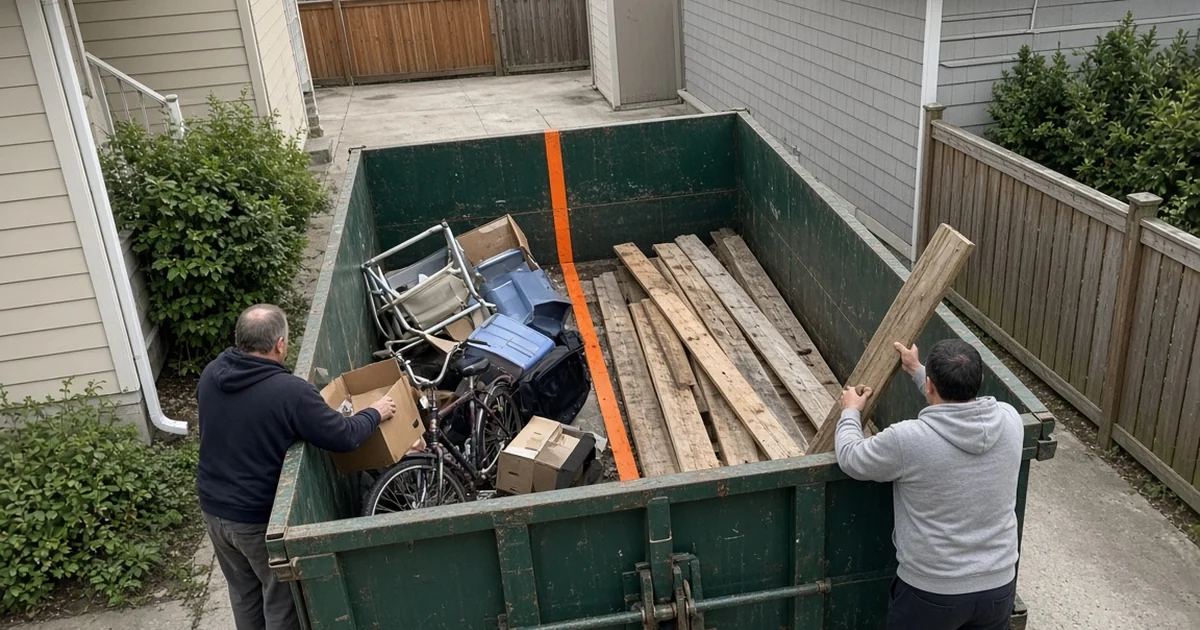
You’re clearing out the garage. Next door, they’re pulling out an old fence. Sharing one bin means one delivery, one spot on the street or driveway and one pickup. It works well when everyone agrees on the details before the truck shows up.
Settle a few things first, split the space and the cost, then load a shared bin without friction.
Settle five things before you book
Sit down with your neighbour for ten minutes and agree on these.
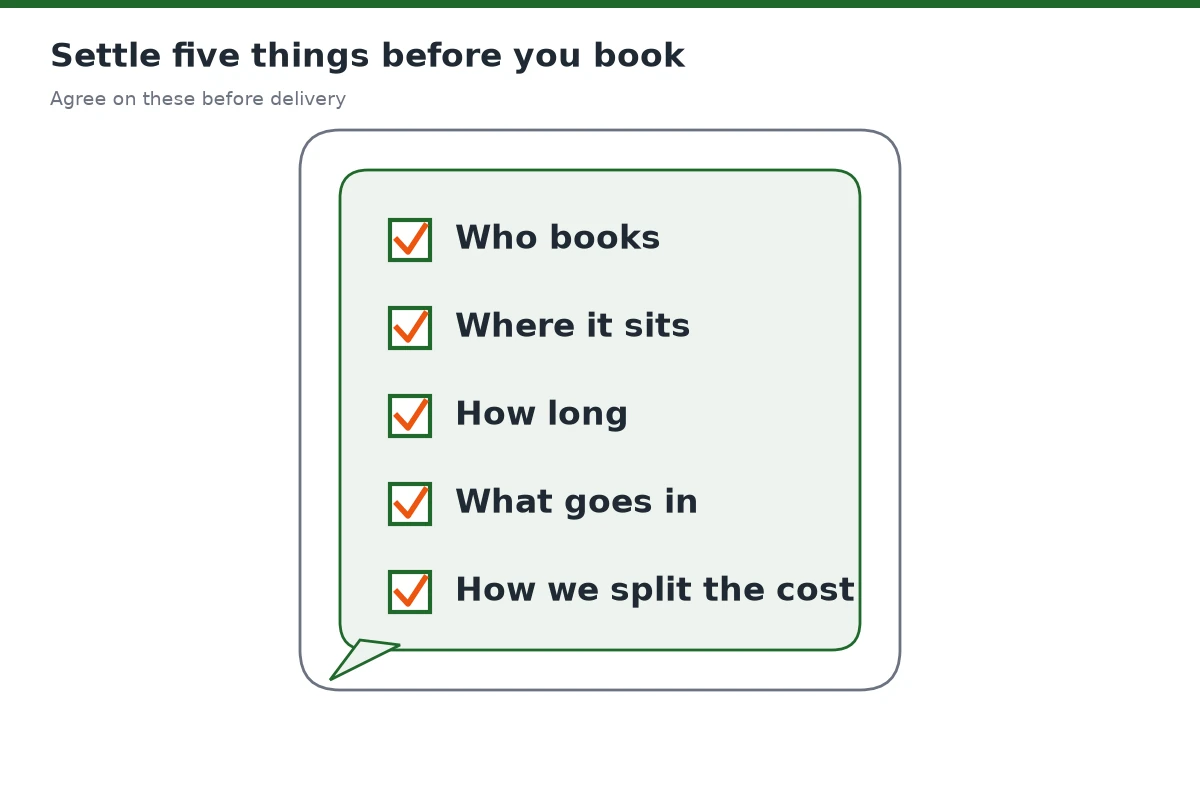
1. Who books and who’s the contact
Decide who will call to book and who your group’s go-to person is for delivery, swaps and pickup. One person orders the bin, and you split the cost between yourselves. We send one invoice to the person who books.
2. Where the bin sits
Pick the driveway with the best truck access, and keep the bin clear of shared access and meters. Our 20 yard bin is about 18 feet long, 8.5 feet wide and 4 feet tall, and sizes vary a little between bins, so measure the spot first. If the bin needs to sit on the street, boulevard or lane, check with your city before delivery, since rules and timelines change often. In a townhouse complex, get strata approval first.
3. How long you’ll keep it
Line up your schedules. Trash King’s guide to how long to keep a rental bin recommends a window that covers the busiest loading days plus a small buffer. If one household finishes days before the other, agree on a firm “done” date.
4. What each household is putting in
Make a rough list each. It helps us confirm the size and catches problem items early. If one of you has dirt, concrete or roofing, tell us. Concrete and dirt each go in their own separate 8 yard or 12 yard bin, call for price.
5. How you’ll split the cost
Agree on this before delivery, not after. More on that below.
Dividing the space
A bin’s volume is easiest to split by length, as a rough planning guide. Picture the 20 yard bin as about 18 feet of floor.
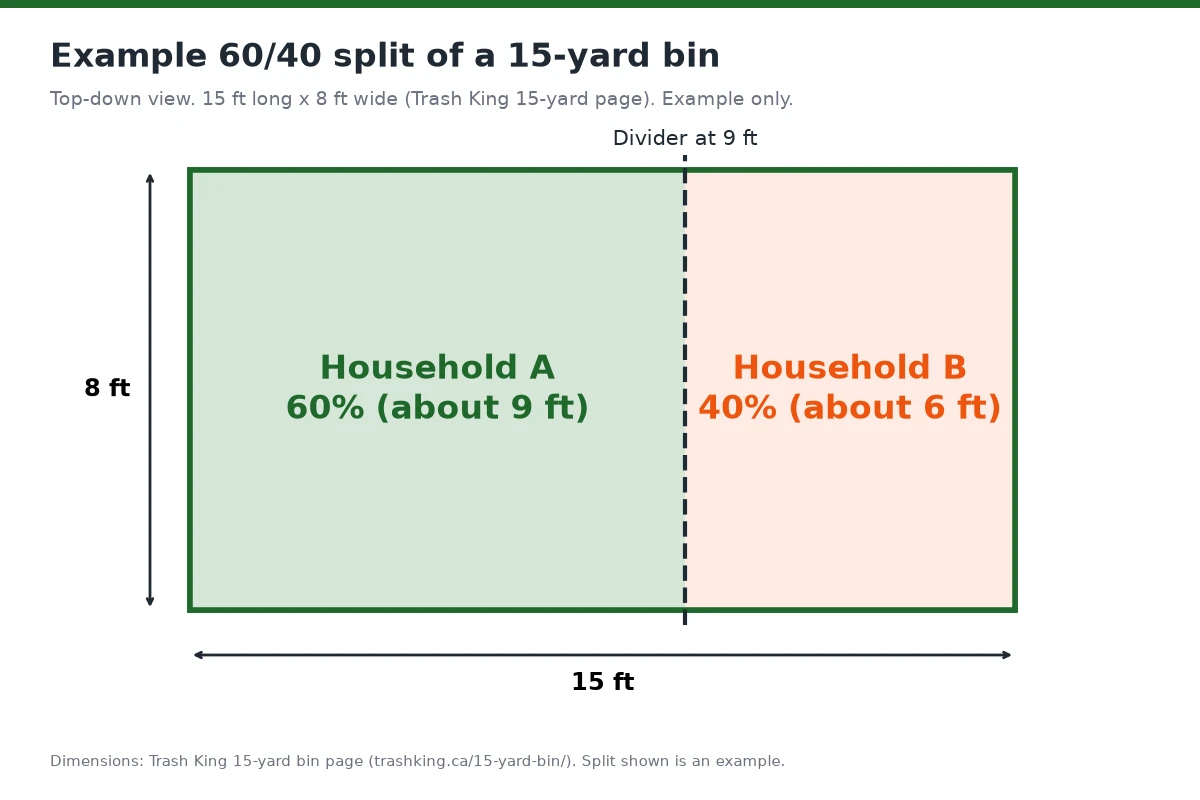
- Even split: each household gets about half the length.
- Uneven split: if one job is clearly bigger, agree on a share. For example, a 60/40 split of a 15-foot bin is about 9 feet and 6 feet.
- First come, first served: works only if the total volume is well under the bin’s size.
Whatever you choose, nothing can go above the rim. Trash King’s loading guide explains that material sticking above the rim can make a load non-compliant for transport until it’s restacked.
Splitting the cost
There’s no single right way. Pick the one that feels fair to both households.
- Even split. Simple, and it works when both jobs are similar.
- Split by share of space. Use the same split you agreed for the length.
- Base plus extras. Split the rental evenly, and whoever causes an extra cost, such as a longer rental or a swap, covers it.
Write it down in a quick text so nobody has to remember later.
Banned items are everyone’s problem
Once it’s loaded, the bin is one load. Trash King’s guide to what not to put in a Metro Vancouver disposal bin says restricted items “can complicate or stop tipping until the load is corrected.” One can of paint from either household affects the whole bin.
Agree that neither of you will load:
- Paint, stains or aerosol cans (take them to a Product Care depot or most Metro Vancouver recycling and waste centres, such as United Boulevard)
- Propane tanks or fuel (most Metro Vancouver recycling and waste centres, such as United Boulevard)
- Tires (a tire retailer or a Tire Stewardship BC collection site)
- Electronics (Return-It sites) and batteries (Call2Recycle drop-offs). Most Metro Vancouver centres, such as United Boulevard, take both.
- Drywall or concrete, unless you’ve booked a separate bin for each
Whoever calls to book will want to know what’s going in, so they can tell us on the call.
Loading a shared bin
A few habits keep it fair and safe:
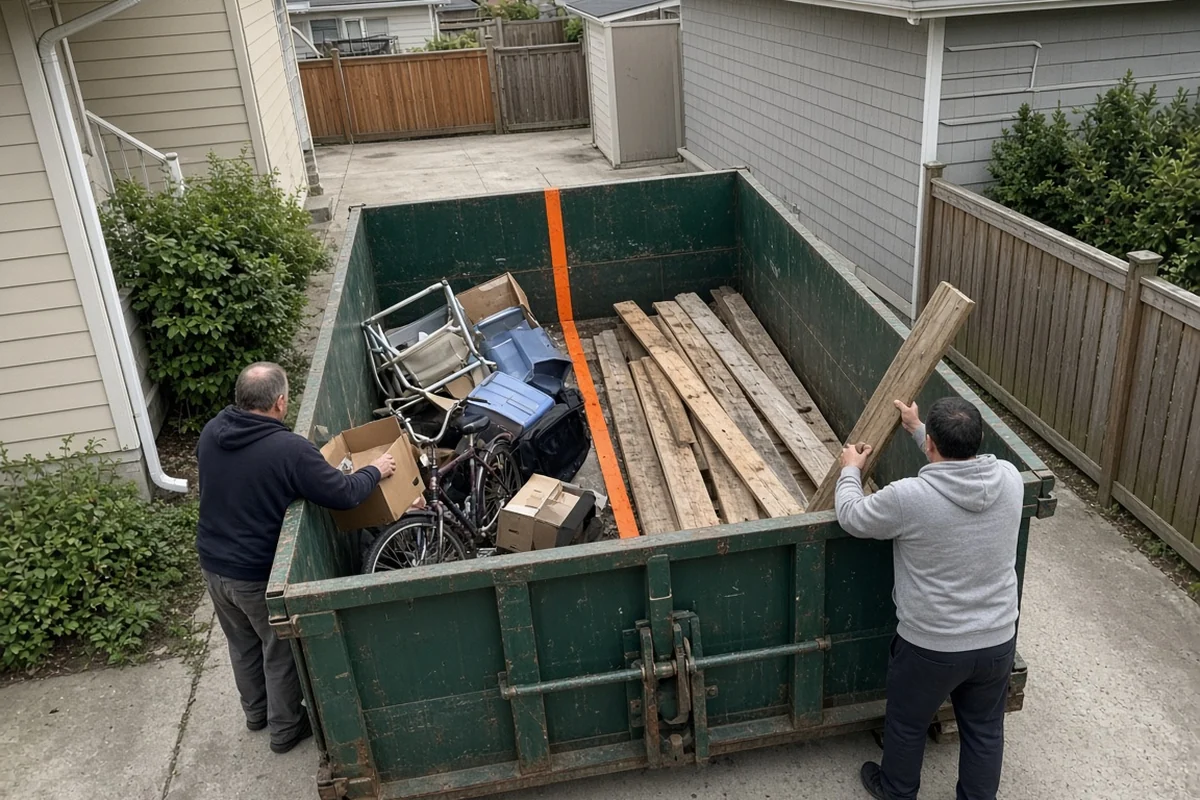
- Load heavy and flat items low. Our loading guide flags weight piled on one end as a common mistake.
- Agree on your section. Decide which end of the bin each household loads, so nobody runs out of room.
- Break things down. Flatten boxes and cut up furniture so neither of you wastes space.
- Check the rim each evening. If it’s getting close, talk before anyone adds more.
Booking a shared bin
Before delivery, go through our shared-bin delivery checklist together so the driveway and approach are clear.
Both households do the loading. We handle the drop-off, and the pickup once it’s full. When you’re ready, call 604-433-5865 or email quotes@trashking.ca with both lists of materials and we’ll help you pick the size.
FAQ
Can two households share one rental bin?
Yes. One person orders the bin and you split the cost yourselves. Agree on who books, where it sits, how long you’ll keep it, what goes in and how you’ll split the cost before it arrives.
How do we split the cost of a shared bin?
Options include an even split, a split by share of space or an even split of the base rental with extras paid by whoever causes them. We send one invoice to whoever books, so write down what you agree.
Whose driveway should the bin go on?
The one with the best truck access and enough room for the bin’s footprint. If it has to go on the street, check with your city first.
What if my neighbour puts in something that isn’t allowed?
Restricted items can hold up the whole load. Agree on the banned list before you start and check the bin before pickup.
What size bin should we share?
Send us both lists. A 20 yard bin is about 18 by 8.5 by 4 feet. Two households often fill more than a 12 yard, so we may suggest a 20 yard when you call. The 12 yard is call for price. Two small bins usually cost more than one 20 yard.
Sources
- Metro Vancouver, GVS&DD Bylaw 379 (consolidated), Schedule C (disposal bans): https://metrovancouver.org/boards/Bylaws/GVSDD_Bylaw_379_Consolidated.pdf (checked 2026-10-30)
- Call2Recycle, battery recycling drop-offs: https://www.call2recycle.ca/ (checked 2026-10-30)
- Trash King, 20 yard bin (18 x 8.5 x 4 ft): https://trashking.ca/20-yard-bin/ (checked 2026-11-17)
- Trash King, How long to keep a rental bin (window covers the debris peak plus a small buffer): https://trashking.ca/how-long-keep-rental-bin-metro-vancouver/ (checked 2026-10-30)
- Trash King, How to load a roll-off bin (material above the rim can make a load non-compliant for transport, weight piled on one end): https://trashking.ca/how-to-load-roll-off-bin-metro-vancouver/ (checked 2026-10-30)
- Trash King, What not to put in a Metro Vancouver disposal bin (you keep banned items out of the bin, restricted items can complicate or stop tipping): https://trashking.ca/what-not-to-put-in-metro-vancouver-disposal-bin/ (checked 2026-10-30)
- Trash King, heavy material bins (8 yard or 12 yard, call for price): https://trashking.ca/heavy-material-bins/ (checked 2026-11-17)
- Metro Vancouver, Disposal Ban Program (program overview, which points to Bylaw 379 for the material lists): https://metrovancouver.org/services/solid-waste/disposal-ban-program (checked 2026-10-30)
- Metro Vancouver, United Boulevard Recycling and Waste Centre (paint, propane, electronics, batteries): https://metrovancouver.org/services/solid-waste/united-boulevard-recycling-and-waste-centre (checked 2026-10-30)
- Product Care Recycling, Household hazardous waste and paint in B.C.: https://www.productcare.org/products/hhw/british-columbia/ (checked 2026-10-30)
- Tire Stewardship BC, Recycle your tires: https://tsbc.ca/recycle-your-tires/ (checked 2026-10-30)
- Return-It Electronics: https://www.return-it.ca/electronics/ (checked 2026-10-30)