
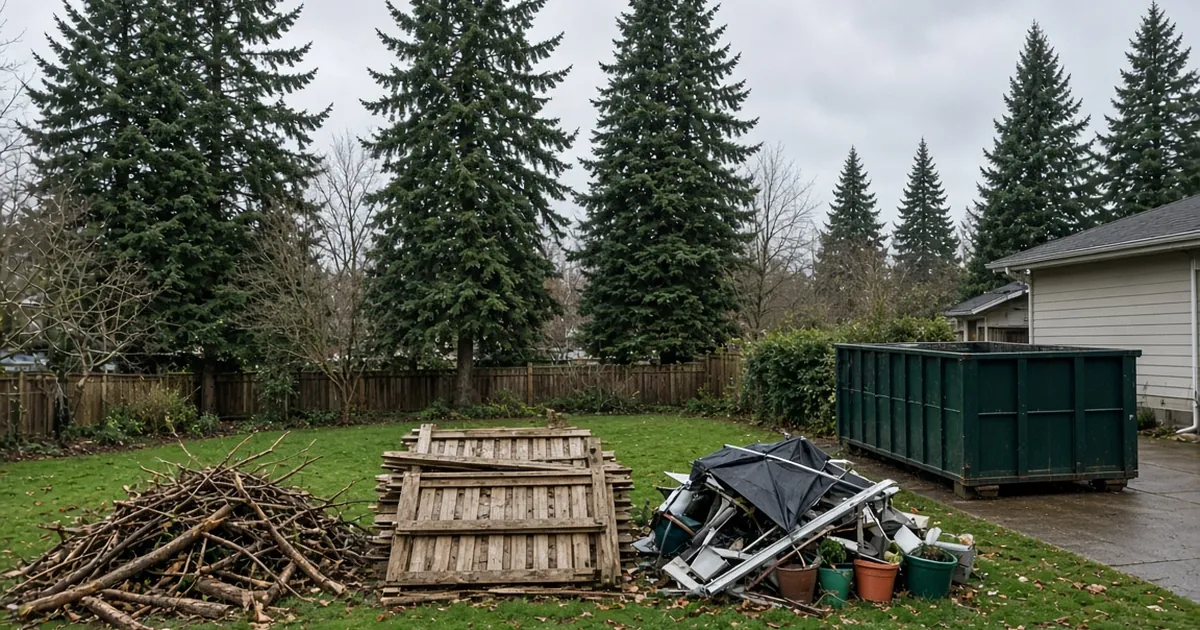
A big windstorm can leave a yard full of branches, a fence panel on the lawn and a limb across the driveway. Before anyone picks up a saw, a few checks keep the cleanup safe and sorted.
Deal with the first steps after a storm, then plan a bin for the debris. You do the cutting and loading, and Trash King hauls the bin away once it’s full.
Safety first: look up before you clean up
BC Hydro says to treat any downed, sagging or damaged power line as live, even if it isn’t sparking or making noise.
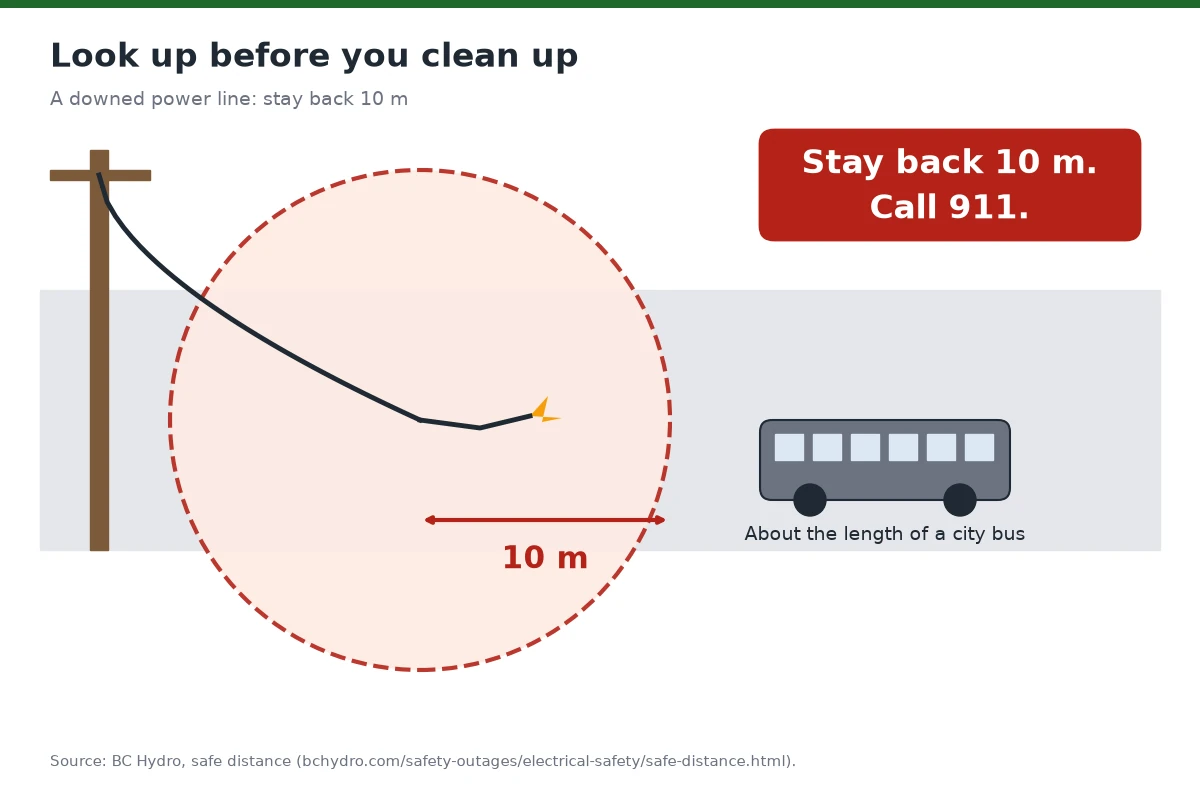
- Stay back at least 10 metres, about the length of a city bus.
- Call 911 to report the line.
- Keep others back the same distance.
- Don’t touch anything in contact with the line. BC Hydro notes that a tree, a vehicle or a fence touching a line can become energized.
If a branch is tangled in wires, leave it. Work only in parts of the yard that are clear of lines. Check for hanging limbs and damaged structures, like a leaning fence or shed, before you work near them.
Work out who handles which tree
Trees on city property
Who handles a tree or limb from a boulevard or park depends on your city, and it’s often the city’s job. In Vancouver, call 3-1-1 at 604-873-7000. Other Metro Vancouver cities have their own service lines on their websites.
Trees on your property
Clearing fallen branches is usually your job as the owner. Removing a whole tree is a different question. The City of Vancouver says you need a tree removal permit for a private tree at least 20 cm in diameter, measured 1.4 metres above the base. A tree that’s dead, dying or a hazard is one of the reasons the City lists for allowing removal. Rules and timelines change often, so check with the City before you take down a damaged tree, and hire an ISA-certified arborist for big trees or hanging limbs. The City’s application needs an arborist report.
On strata property, the City asks for a letter of consent from the strata council president or vice-president.
Other cities, like Burnaby, Surrey and the North Shore municipalities, set their own tree rules. Check your city’s tree bylaw before removing a tree.
Take photos before you move anything
If you plan an insurance claim, photograph the damage first: the fallen limb, the broken fence, any damage to the roof or car. Ask your insurer what they need before the debris leaves the property.
Sort the debris into three piles
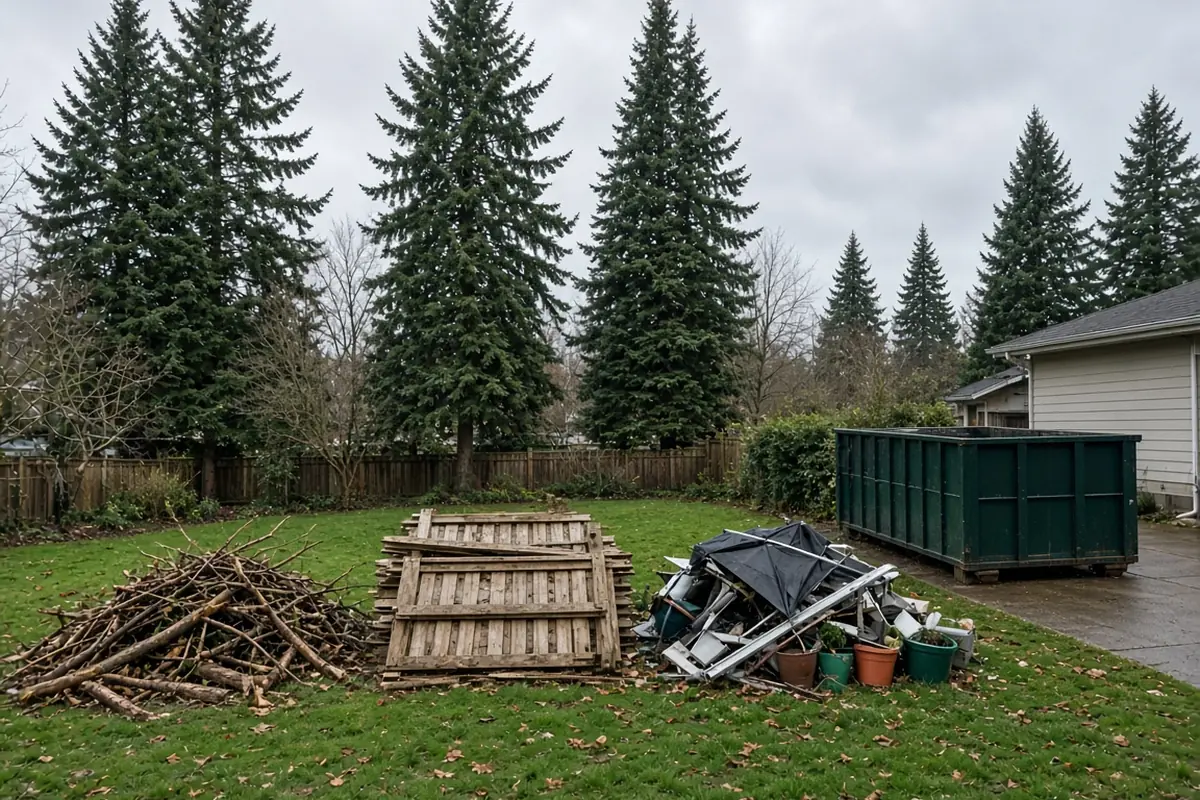
Storm debris is mixed. Sorting on the lawn saves trouble at the bin.
1. Green waste
Branches, limbs, leaves and twigs. Yard trimmings are one of Metro Vancouver’s banned recyclables in garbage, so keep them apart from household junk. See our organics recycling page for how green loads work, and tell us when you book.
2. Fence panels and posts
Broken cedar panels, rails and posts. Fence posts are often pressure-treated. Keep treated wood out of clean-wood and yard loads, and never put it in with branches. Tell us about treated or painted wood when you book, since it needs special handling. See our wood page and mention treated posts when you call. Chain-link and metal panels can go to the metal pile.
3. Everything else
Broken patio furniture, a smashed shed roof, blown-over planters and other household debris.
If a fence post comes up with a concrete footing attached, set it aside and tell us. Concrete goes in its own separate bin.
Cut it so it packs
Branches fill a bin quickly because they’re bulky. Cut limbs into shorter lengths and strip side branches so the pieces lie flat. Stack them in one direction. Break fence panels down at the rails.
Wet branches and leaves weigh more than dry ones. Bins drain through built-in holes, so only cover the load if a serious rainstorm is coming.
Pick a bin or a depot run
For a few branches, a trailer trip to a Metro Vancouver recycling and waste centre can work, and rates vary by facility. As of October 2026, Metro Vancouver’s United Boulevard rates list:
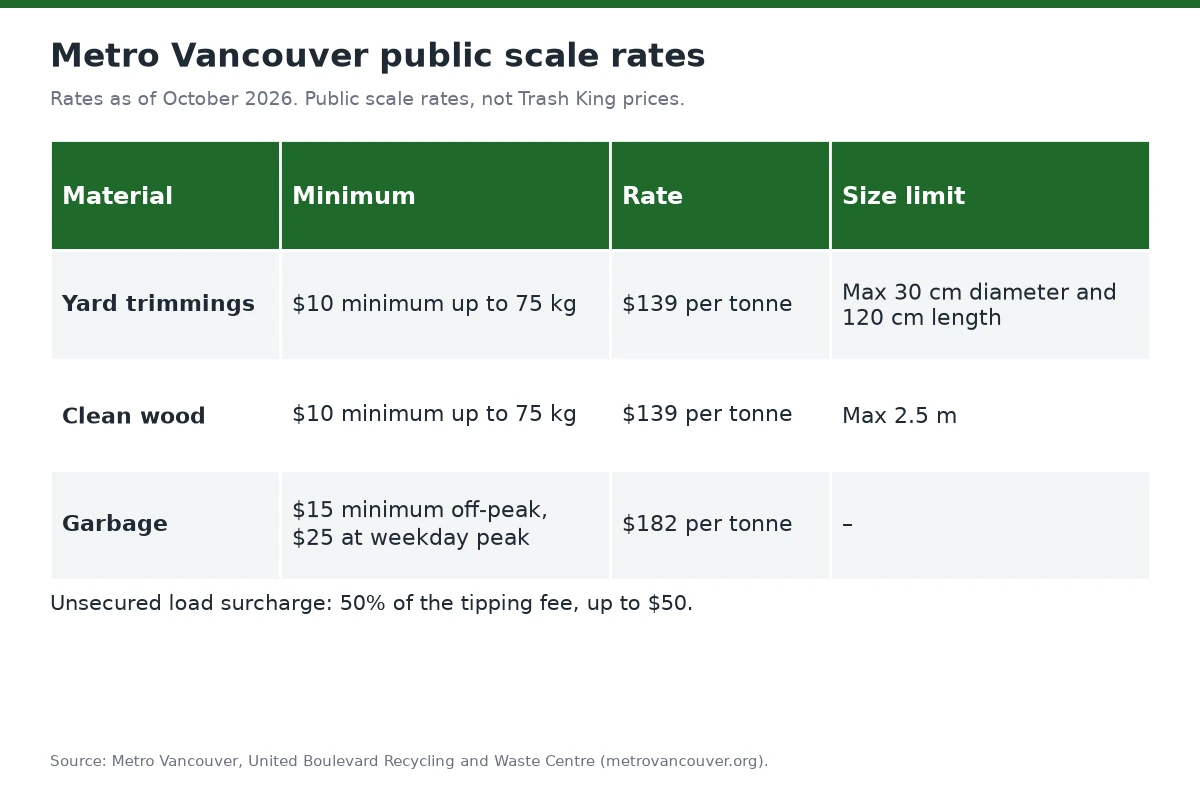
- Yard trimmings: $10 minimum for loads up to 75 kg, then $139 per tonne. Branches and stumps up to 30 cm in diameter and 120 cm long.
- Clean wood: $10 minimum, $139 per tonne, up to 2.5 m long. It must be unpainted, unstained and untreated.
- Garbage: $15 minimum per load outside weekday peak hours and $25 from 10 am to 2 pm, then $182 per tonne under 1 tonne.
Secure your load. Metro Vancouver applies a surcharge of 50% of the tipping fee, up to $50, on unsecured loads.
For a yard full of limbs plus a fence, a DIY bin saves the trips. Tell us what’s in each pile when you call 604-433-5865 and we’ll help you choose a size and stream. Our yard waste bin guide and fence and deck tear-down guide have more on each load type.
Placement after a storm
Pick a spot clear of fallen limbs, overhead wires and soft, waterlogged lawn. A driveway is usually best. If the bin has to go on the street, check with your City about a permit first, since rules and timelines change often. Our DIY roll-off prep steps take care of the rest.
Paint, propane, fuel and tires never go in the bin. If the storm knocked over a barbecue or a shed full of cans, set those items aside for a drop-off. See our residential services for booking.
FAQ
What do I do if a tree branch is on a power line?
Stay at least 10 metres away and call 911, as BC Hydro advises. Don’t touch the branch or anything touching the line.
Who cleans up a fallen city tree?
Usually your city, but each city sets its own rules. In Vancouver, call 3-1-1.
Do I need a permit to remove a storm-damaged tree in Vancouver?
The City of Vancouver requires a permit for private trees at least 20 cm in diameter at 1.4 metres. Rules and timelines change often, so check with the City before removing one.
Can branches and broken fence panels go in the same bin?
Tell us what’s in the mix when you book. Green waste, treated posts and general debris can each need a different plan. Treated posts never go in with branches. Tell us about treated or painted wood when you book, since it needs special handling.
Does Trash King cut and load storm debris?
No. The cutting and loading are yours, and we deliver and haul the bin.
Sources
- Metro Vancouver, Tipping Fee page (fees starting July 1, 2026: garbage $182 per tonne under 1 tonne, yard trimmings and clean wood $139 per tonne, $15 minimum per load off-peak and $25 at weekday peak 10 am to 2 pm, peak rule not applied at Central Surrey, Langley and Maple Ridge, as of October 2026): https://metrovancouver.org/services/solid-waste/tipping-fee (checked 2026-10-30)
- Metro Vancouver, GVS&DD Bylaw 379 (consolidated), s.7.9 (surcharge applies when banned recyclables are more than 5% of a load by weight or volume) and the unsecured-load surcharge: https://metrovancouver.org/boards/Bylaws/GVSDD_Bylaw_379_Consolidated.pdf (checked 2026-10-30)
- BC Hydro, Safe distance from downed power lines (assume live, stay back 10 metres, call 911, objects in contact can be energized): https://www.bchydro.com/safety-outages/electrical-safety/safe-distance.html (checked 2026-10-30)
- City of Vancouver, Get a tree removal permit (20 cm diameter at 1.4 m, dead, dying or hazard as a reason, ISA-certified arborist report, strata council consent, 3-1-1 604-873-7000): https://vancouver.ca/home-property-development/tree-removal-permit.aspx (checked 2026-10-30)
- Metro Vancouver, United Boulevard Recycling and Waste Centre (yard trimmings $10 minimum up to 75 kg, $139 per tonne, 30 cm by 120 cm limits, clean wood 2.5 m, garbage $15 minimum up to 55 kg, $182 per tonne, unsecured load surcharge 50% up to $50): https://metrovancouver.org/services/solid-waste/united-boulevard-recycling-and-waste-centre (checked 2026-10-30)
- Metro Vancouver, Disposal Ban Program (yard trimmings as a banned recyclable): https://metrovancouver.org/services/solid-waste/disposal-ban-program
- Trash King, Yard waste bin rental (storm weeks create sudden branch piles, wet brush weighs more): https://trashking.ca/yard-waste-bin-rental-greater-vancouver/ (checked 2026-10-30)
- Trash King, Wood (treated and clean wood are different loads): https://trashking.ca/wood/ (checked 2026-10-30)
- Trash King, Organics recycling: https://trashking.ca/organics-recycling/ (checked 2026-10-30)