
British Columbia has a long list of programs that take products back at the end of their life. Many are funded by the businesses that make or sell the product, so drop off is often free at the depot. This hub guide shows what each program covers and where to read more. Some of the items here are the ones that cause the most trouble in a cleanout, and none of them belong in a Trash King bin.
How BC take back programs work
Under BC's rules, producers are responsible for the products they sell, and each stewardship program runs the collection. For example, Recycle BC says its program is funded by businesses that supply packaging and paper to BC residents. Product Care says its light recycling program is funded by eco fees charged on the sale of new lighting products.
Not every depot takes every program. Confirm with a specific depot before you go. Hours, limits and accepted items change.
The programs at a glance
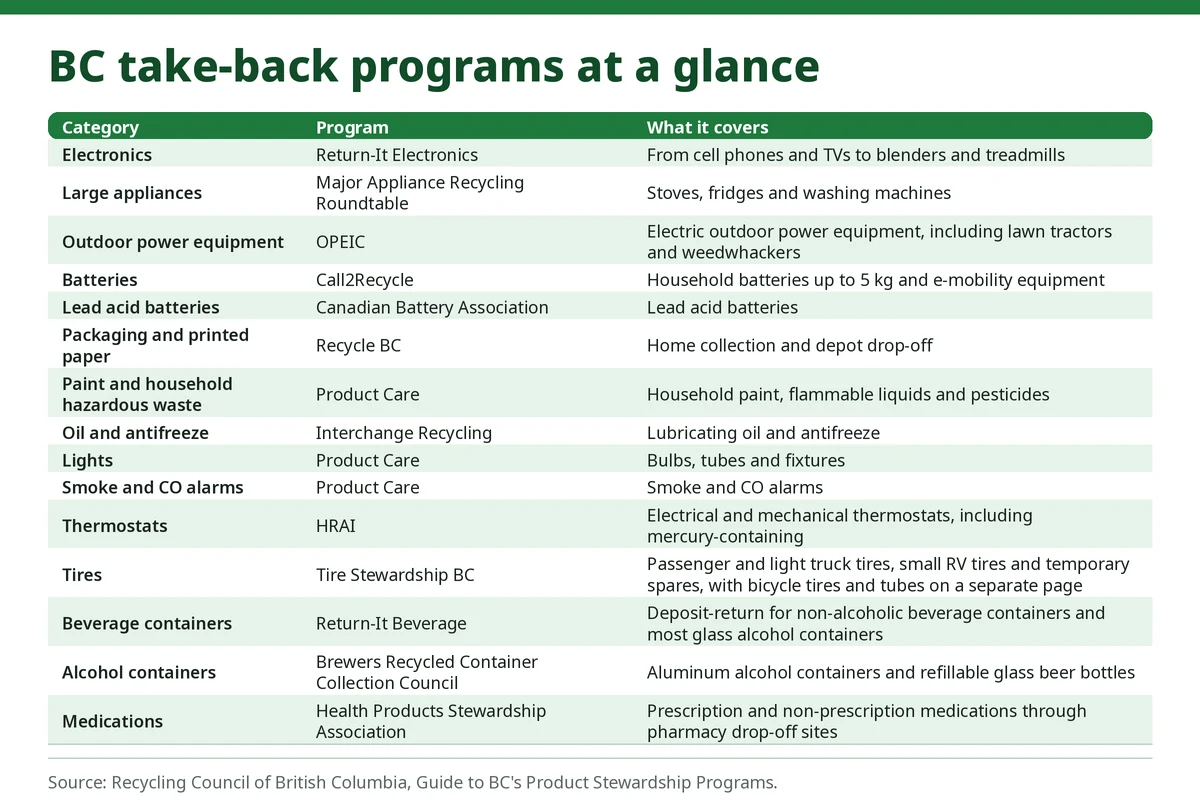
The Recycling Council of British Columbia (RCBC) publishes "A Guide to BC's Product Stewardship Programs." It lists these programs, and we repeat the main ones here.
| Category | Program | What it covers, per RCBC |
|---|---|---|
| Electronics | Return-It Electronics | From cell phones and TVs to blenders and treadmills |
| Large appliances | Major Appliance Recycling Roundtable | Stoves, fridges and washing machines |
| Outdoor power equipment | OPEIC | Electric outdoor power equipment, including lawn tractors and weedwhackers |
| Batteries | Call2Recycle | Household batteries up to 5 kg and e mobility equipment |
| Lead acid batteries | Canadian Battery Association | Lead acid batteries |
| Packaging and printed paper | Recycle BC | Home collection and depot drop off |
| Paint and household hazardous waste | Product Care | Household paint, flammable liquids and pesticides |
| Oil and antifreeze | Interchange Recycling | Lubricating oil and antifreeze |
| Lights | Product Care | Bulbs, tubes and fixtures |
| Smoke and CO alarms | Product Care | Smoke and CO alarms |
| Thermostats | HRAI | Electrical and mechanical thermostats, including mercury containing |
| Tires | Tire Stewardship BC | Passenger and light truck tires, small RV tires and temporary spares, with bicycle tires and tubes on a separate page |
| Beverage containers | Return-It Beverage | Deposit return for non alcoholic beverage containers and most glass alcohol containers |
| Alcohol containers | Brewers Recycled Container Collection Council | Aluminum alcohol containers and refillable glass beer bottles |
| Medications | Health Products Stewardship Association | Prescription and non prescription medications through pharmacy drop off sites |
Return-It
Return-It is the name behind two programs. Return-It Beverage is the deposit return program for beverage containers. Return-It Electronics takes end of life electronics. Metro Vancouver's battery page also says electronics and small household appliances with embedded batteries are collected through the Return-It Electronics program. Check Return-It's site for a list of accepted products and depot locations.
For electronics, see our electronics page and our guide to safely recycling electronics, batteries and e-waste.
Batteries
Metro Vancouver says single use (alkaline), rechargeable and e mobility batteries are included in a province wide program provided by Call2Recycle. Metro Vancouver recycling and waste centres accept batteries at no charge, and staff can show you where to place them. Lithium ion batteries cause most battery related fires at Metro Vancouver facilities, so never put them in the garbage or blue bin.
Lights, alarms and thermostats
Product Care's BC lights page says you can return up to 16 bulbs and up to 16 tubes at once. For smoke and CO alarms, its BC page says you can drop off up to 40 at once at more than 200 locations. Thermostats go to a separate program.
Tires, propane and other items
Our live posts cover two of these. See our guide to old tire disposal in Metro Vancouver and our guide to propane tanks, fuel and old BBQs. Tire Stewardship BC says there are Return to Retailer locations across BC and recommends calling ahead to confirm space. See its tire recycling page for accepted tires.
Where to find the nearest drop off
- Metro Vancouver Recycles. Search a material to find a location.
- RCBC Recyclepedia and hotline. RCBC's Information Services Contact Centre helps with depot locations and program requirements.
- The program's own locator. Product Care and Call2Recycle have locators on their sites.
- Your city's tool, such as the City of Vancouver's Waste Wizard.
Never in a bin
These items are the ones that cause rejected loads and safety problems. Paint, propane, tires, fuel and electronics never go in a Trash King bin, and the same goes for the other items on our what not to put in a bin page. For all of them, use the programs above.
For the rest of the cleanout
After the take back items are out, the non hazardous rest can go in a bin. For junk, cleanouts and renos, the 20-yard is the common starting size. A 15-yard junk bin is at times available, but it is commonly sold out, so plan around the 20-yard. Ask us about other smaller sizes when you book. You can read more on the 20-yard bin page.
We deliver the bin, you load it, and Trash King hauls it away.
No permit is needed for a bin on private property, like your driveway or yard. Some cities need a permit for a bin on the street, boulevard or lane, so confirm with your City before you book. Strata or HOA rules may still apply on top of that. If yours does, apply with the City, and we will time delivery to any permit dates.
Need to get rid of a mattress or box spring? It can go in as an add on for an added fee. Mention it when you book.
Our household garbage page covers how that works.
FAQ
What is Return-It? RCBC lists Return-It Electronics and Return-It Beverage as two separate programs. One is for end of life electronics and the other is a deposit return program for beverage containers.
Who takes household batteries? Call2Recycle runs the province wide program, according to Metro Vancouver.
Where do I take paint? Product Care manages the program for household paint, according to RCBC. Check Product Care's site for locations.
Do tires go in a bin? No. Tires never go in a Trash King bin. Use the tire program.
Is drop off always free? Many programs are funded by producers, but each program and depot has its own rules. Check before you go.