
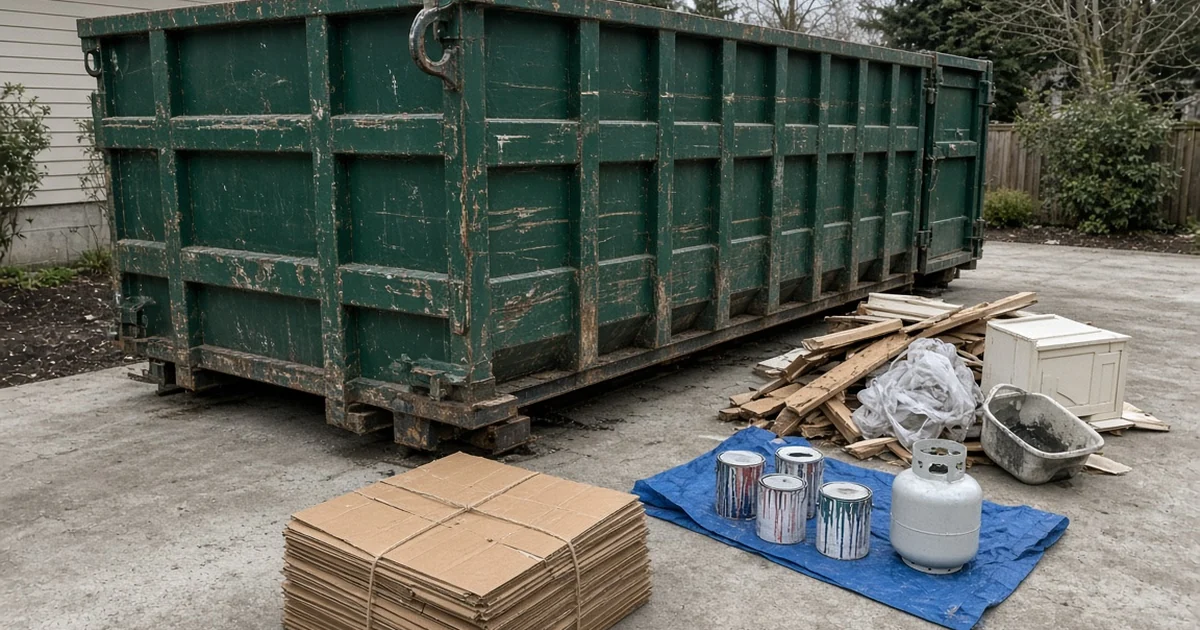
Every load of garbage that rolls onto the scale at a Metro Vancouver or City of Vancouver disposal facility can be inspected. Inspectors look for materials that are banned from the garbage. If they find them, a surcharge lands on the load.
In short, the Metro Vancouver disposal ban keeps recyclables, stewardship products and hazardous items out of garbage loads, and a load that breaks the rules pays a surcharge. There are three groups of banned materials, each with its own rule. Once you know them, a 20-minute sorting routine keeps banned items out of your bin.
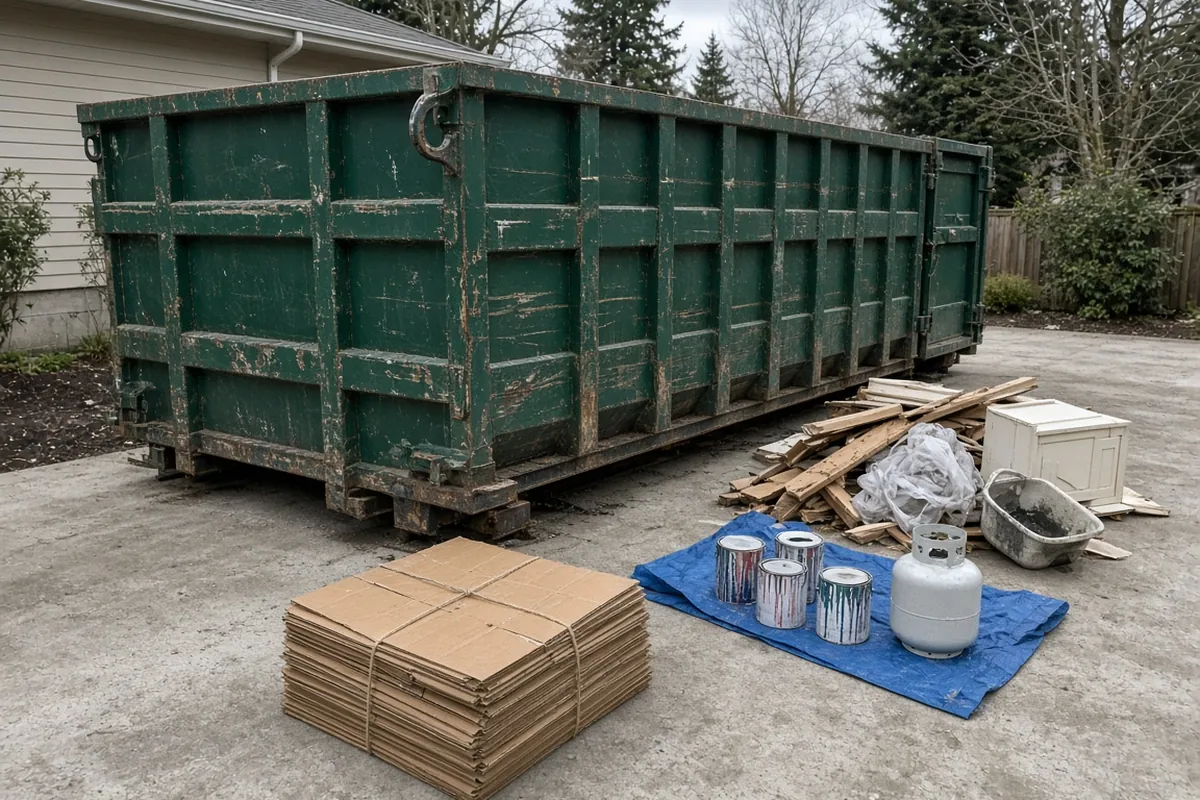
How the Metro Vancouver disposal ban works
Metro Vancouver bans materials from the garbage for two reasons. Some are easy to recycle, so burying them wastes them. Others are hazardous to workers, the public or the environment, or they cause problems at the facility.
Inspectors check loads at the facility. For some materials they estimate a percentage of the load. For others, a single item is enough. The current rules sit in Metro Vancouver’s Tipping Fee and Solid Waste Disposal Regulation Bylaw, and the 2026 Disposal Ban Program Manual explains how inspections work.
The three groups of banned materials
1. Banned recyclables
Each of these has recycling options across the region:
- Corrugated cardboard and recyclable paper
- Clean wood
- Yard trimmings
- Food waste
- Beverage containers, and containers made of glass, metal, recyclable plastic (1, 2, 4 and 5) or composite materials
- Expanded polystyrene (foam) packaging
- Auto parts and bodies
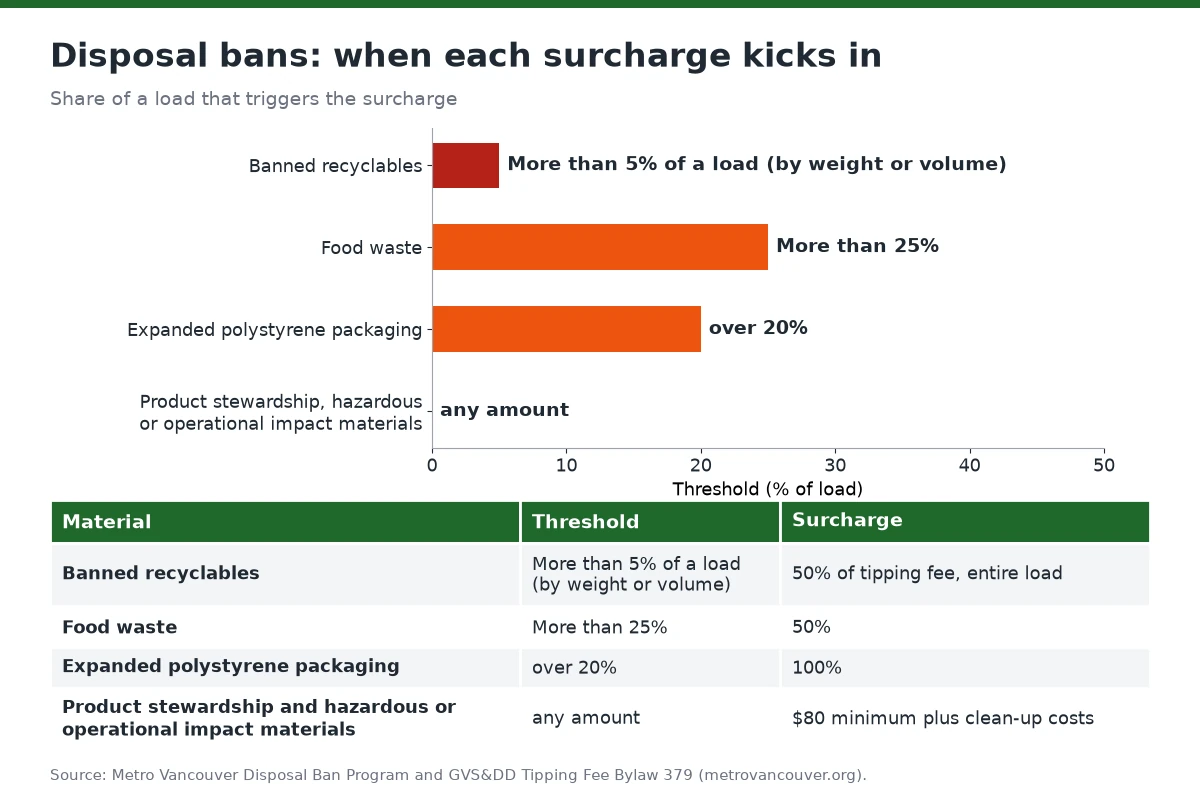
The rule: a load is surcharged at 50% of the tipping fee on the entire load when banned recyclables make up more than 5% of a load by weight or volume. Food waste has a higher threshold: more than 25% of a load by weight or volume. Foam packaging is its own case. A load with more than 20% foam packaging gets a 100% surcharge, because foam is so light.
2. Product stewardship materials
These have provincially regulated recycling programs with drop-off sites across B.C.:
- Paint and paint containers
- Flammable liquids, solvents and gasoline
- Oil, oil filters, oil containers and antifreeze
- Batteries, including lead acid batteries
- Fluorescent lights and thermostats
- Electronic and electrical products, including many metal household appliances
- Pesticides, pharmaceuticals and tires
The rule: any amount triggers it. Metro Vancouver applies an $80 minimum surcharge to the load, plus any cost of removal, clean-up or remediation.
3. Hazardous and operational impact materials
This group is hazardous, or it jams up how a facility runs:
- Asbestos and hazardous waste
- Propane tanks and flammable materials
- Gypsum (drywall) and mattresses
- Creosote-treated wood and railroad ties
- Liquids and sludge, and containers bigger than 205 litres
- Wire, hosing, rope and cable over 1 metre
- Single objects over 100 kg, 2.5 metres long or 1.2 metres wide
- Inert fill such as soil, sod, gravel, concrete and asphalt over 0.5 cubic metres per load
The rule: the same as product stewardship materials. One item is enough for the $80 minimum surcharge plus clean-up costs.
The whole program at a glance:
| Material group | When the surcharge applies | Surcharge | Where it goes instead |
|---|---|---|---|
| Banned recyclables: cardboard, paper, clean wood, yard trimmings, containers | More than 5% of a load by weight or volume | 50% of the tipping fee on the whole load | Recycle it separately. Clean wood and yard trimmings can go to a recycling and waste centre as their own load. |
| Food waste | More than 25% of a load by weight or volume | 50% of the tipping fee on the whole load | Keep it separate for food scraps recycling. |
| Expanded polystyrene (foam) packaging | More than 20% of the load | 100% of the tipping fee | Free residential foam drop-off at centres such as United Boulevard in Coquitlam. |
| Product stewardship: paint, solvents, batteries, electronics, tires | Any amount | $80 minimum plus clean-up costs | Product Care Recycling for paint, Tire Stewardship BC for tires, the Metro Vancouver Recycles directory for the rest. |
| Hazardous and operational impact: asbestos, propane tanks, drywall, mattresses, inert fill over 0.5 cubic metres | Any amount (inert fill over 0.5 cubic metres) | $80 minimum plus clean-up costs | Test for asbestos first. Find propane drop-offs in the Metro Vancouver Recycles directory. Drywall and concrete each go in their own separate bin, and a mattress can be added to a bin for an extra fee. Tell us about them when you book. |
What this means for a DIY bin
With a Trash King bin, you load it and we haul it to a licensed facility. The ban list still applies to what’s in the bin. Sorting at home is the easy part of the job, and it keeps your load simple to tip. Our load-day prep checklist covers the rest of delivery day.
Here’s how the three groups play out on a typical project.
Keep these out of the bin completely
Paint, propane tanks, fuel and tires never go in the bin. Set them aside the day before delivery:
- Paint: take it to a Product Care Recycling drop-off. Their locator lists sites near you.
- Tires: take them to a Tire Stewardship BC return site.
- Propane tanks, fuel and other household hazardous products: search the Metro Vancouver Recycles directory for the nearest location that takes them.
- Electronics and batteries: see our page on electronics for options.
Tell us before you load these
Some materials are banned from the garbage but still have a path when they’re kept separate. Mention them when you book.
- Drywall. Gypsum is on the ban list for garbage. Drywall goes in its own separate bin. See drywall.
- Clean wood. Untreated lumber is a banned recyclable. Mention treated or painted wood when you book, since it needs special handling. A lumber-heavy job may suit a separate wood load.
- Concrete, dirt and sod. Inert fill over 0.5 cubic metres is banned from garbage. Concrete goes in its own separate bin, and so do heavy dirt and sod loads. See concrete.
- Mattresses. A mattress can be added to your bin for an extra fee. Give us a count on the call.
- Cardboard. Break it down and recycle it. A big pile of boxes can push a load over the 5% limit on its own.
Stop and test first
Asbestos is a hazardous material on the ban list. WorkSafeBC says a home built before 1990 is likely to contain some asbestos, and newer homes can too if older materials were used. If your reno will disturb flooring, drywall compound, stucco or insulation, hire a licensed asbestos surveyor before demo. The bin waits until the report is back.
A 20-minute sorting routine
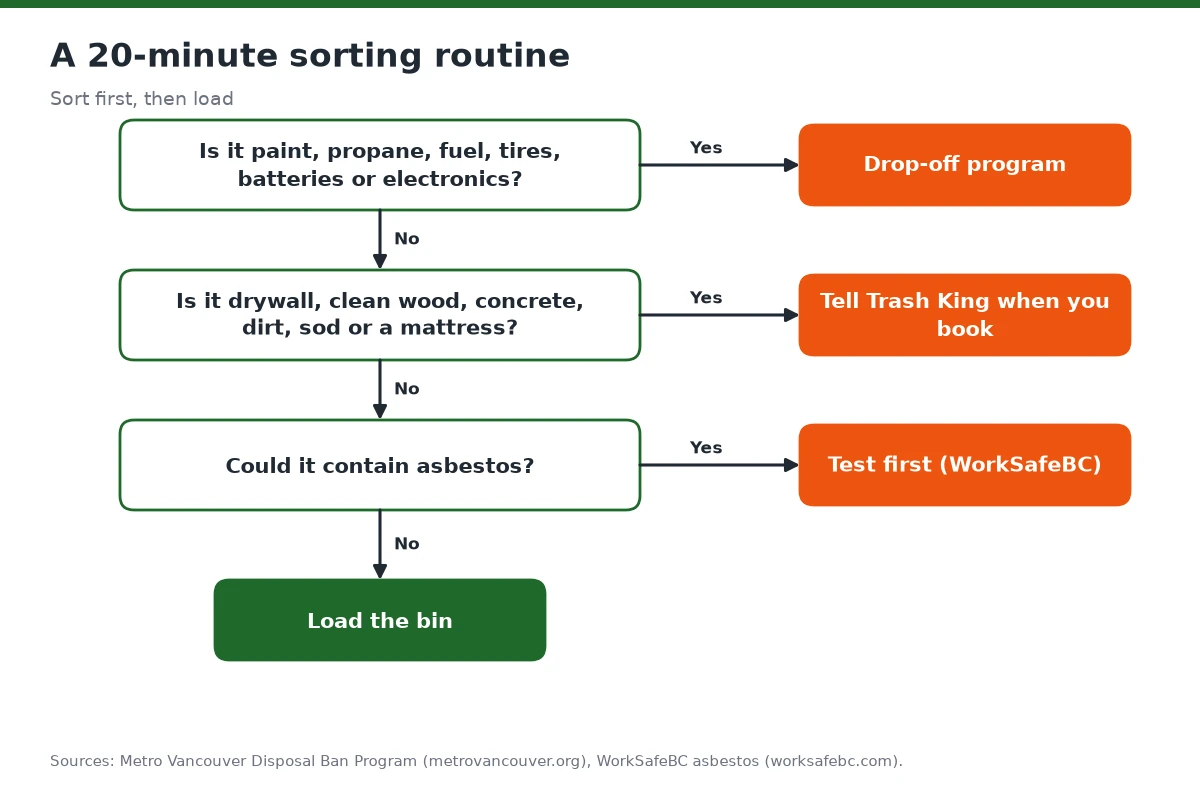
- Walk the pile with three boxes: “drop-off”, “tell Trash King”, and “bin”.
- Pull the drop-off items first. Paint, propane, fuel, tires, batteries, electronics and chemicals.
- Flatten cardboard and set it aside for recycling.
- Group the heavy stuff. Concrete, brick, soil and sod get their own pile.
- Count the specials. Mattresses, drywall sheets and bundles of clean lumber.
- Check for long items. Cable, hose and rope over a metre, and anything big enough to hit the single-object limits.
- Call us at 604-433-5865 with what’s in each pile, so we can match the bin to the load.
Where the rules apply
Surcharges apply at Metro Vancouver and City of Vancouver solid waste facilities. That covers the recycling and waste centres in Coquitlam, North Vancouver, Surrey, Langley and Maple Ridge, plus the Vancouver Landfill in Delta and the Vancouver South Transfer Station. If you self-haul to one of them, you pay any surcharge at the scale. Our post on what not to put in a Metro Vancouver disposal bin is the quick item list to keep on your phone.
Ready to book? Start with our disposal bins page or call 604-433-5865.
FAQ
What is the Metro Vancouver disposal ban surcharge?
It’s an extra charge on a garbage load that contains banned materials. Banned recyclables over the threshold bring a 50% surcharge on the tipping fee for the entire load. Hazardous and product stewardship items bring an $80 minimum surcharge plus any clean-up costs.
How much cardboard can be in a load?
Banned recyclables, including cardboard, trigger the surcharge when they make up more than 5% of a load by weight or volume. The simplest plan is to recycle cardboard separately.
Can paint go in a bin if the can is dry?
Paint and paint containers are product stewardship materials, so keep them out of the bin. Take them to a Product Care Recycling drop-off.
Is drywall banned in Metro Vancouver?
Gypsum is banned from the garbage at regional facilities. Drywall goes in its own separate bin, so tell us about it when you book.
Where can I check the full list?
Metro Vancouver’s Disposal Ban Program page links to the Tipping Fee Bylaw, which has the full list.
Sources
- Metro Vancouver, Disposal Ban Program (three material groups, $80 minimum, 50% and 100% surcharges, full lists): https://metrovancouver.org/services/solid-waste/disposal-ban-program (checked 2026-10-29)
- Metro Vancouver, Disposal Ban Program Manual 2026 (inspections, 5%, 25% and 20% thresholds): https://metrovancouver.org/services/solid-waste/Documents/disposal-ban-program-manual.pdf
- Metro Vancouver, Tipping Fee and Solid Waste Disposal Regulation Bylaw No. 379 (s.7.9: surcharge when banned recyclables are more than 5% of a load by weight or volume, Table 4 surcharges): https://metrovancouver.org/boards/Bylaws/GVSDD_Bylaw_379_Consolidated.pdf
- Metro Vancouver, Recycling and Waste Facilities: https://metrovancouver.org/services/solid-waste/recycling-waste-facilities
- Metro Vancouver Recycles directory: https://recycling.metrovancouver.org/
- Product Care Recycling, paint in B.C.: https://www.productcare.org/products/paint/british-columbia/
- Tire Stewardship BC, Recycle your tires: https://tsbc.ca/recycle-your-tires/
- WorkSafeBC, asbestos testing before renovation: https://www.worksafebc.com/en/about-us/news-events/campaigns/asbestos