
Businesses in Metro Vancouver often ask what the regional rules mean for what goes in their garbage. The regional rules work through the Disposal Ban Program. It applies at disposal facilities, so what a business sends out in its garbage, directly or through a hauler, matters. This guide covers the program in plain terms, using Metro Vancouver's published manual. It is an explainer, not legal advice, and the Tipping Fee Bylaw takes precedence. For commercial service, see our commercial services page. For a consumer focused look at surcharges, see our disposal ban guide.
How the rules work
Metro Vancouver's Disposal Ban Program Manual says banned materials are specified in the Tipping Fee Bylaw, that loads received at Metro Vancouver and City of Vancouver facilities are visually inspected for banned materials, and that surcharges are levied if banned materials are present beyond set thresholds. It says over 50 materials are included. The program began in 1997 with a cardboard ban.
In practice, the bans are enforced where garbage is tipped. If your business hires a hauler, ask whether surcharges are passed on to you and what your hauler needs you to separate.
Banned recyclable materials
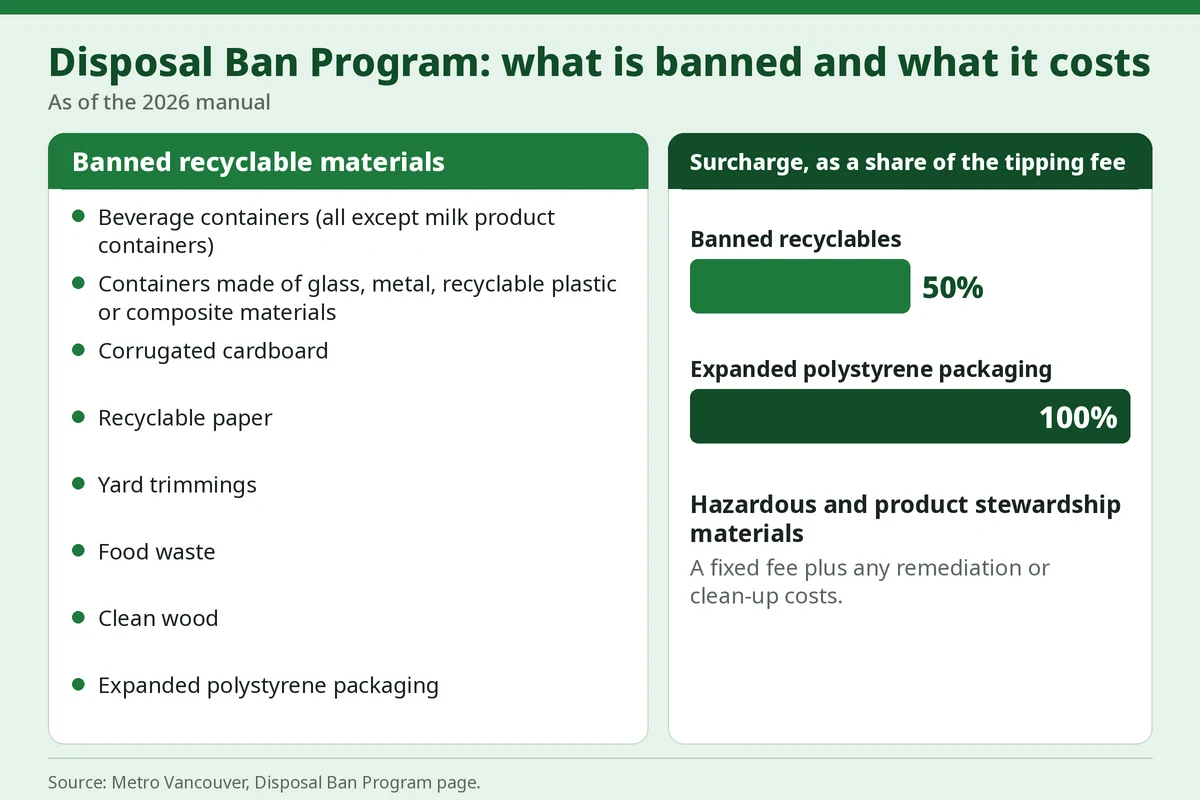
As of the 2026 manual, the banned recyclable materials include:
- Beverage containers (all except milk product containers)
- Containers made of glass, metal, recyclable plastic or composite materials
- Corrugated cardboard
- Recyclable paper
- Yard trimmings
- Food waste
- Clean wood
- Expanded polystyrene packaging
Banned hazardous and product stewardship materials
The manual also lists hazardous and operational impact materials, including agricultural waste, automobile bodies and parts, hazardous waste, propane tanks, liquids and sludge, gypsum, mattresses, railroad ties or creosote treated wood, and single objects over 100 kg, 2.5 metres long or 1.2 metres wide.
Product stewardship materials on the list include solvents and flammable liquids, pesticides, gasoline, pharmaceutical products, oil and oil containers, paint, lead acid batteries, antifreeze, electronic and electrical products and tires.
Thresholds and surcharges
The manual says most banned recyclable materials have a threshold of 5% of a load by weight or volume, with the combination of all banned materials not to exceed 5%. Food waste has a threshold of 25% and expanded polystyrene 20%. For hazardous and operational impact materials and product stewardship materials, a single item can trigger a surcharge.
Surcharge levels, as the manual describes them:
- Hazardous and product stewardship materials: a fixed fee plus any remediation or clean up costs
- Banned recyclables: 50% of the tipping fee
- Expanded polystyrene packaging: 100% of the tipping fee
Metro Vancouver's disposal ban page lists the current fixed fee. Check it, since amounts change.
What happens during an inspection
According to the manual, inspectors scan vehicles, watch loads as they are unloaded, and inspect the garbage again once unloaded. If a load has banned materials, the inspector informs the customer of the pending surcharge where practical and may offer options for recycling, reuse or safe disposal. If it is safe, customers may be allowed to reload banned materials, and no surcharge notice is issued if they do. There is typically no option to reload at pit style facilities.
Commercial recycling options
Metro Vancouver's recycling centres say commercial customers use a dedicated bin for commercial cardboard, and some materials are accepted from residents only. For commercial recycling options, Metro Vancouver points businesses to the RCBC Recycling Hotline at 604 RECYCLE or info@rcbc.ca.
Practical steps for a business
- Ask your hauler what it needs separated and how loads are billed.
- Set up separate collection for cardboard, paper, containers and food waste where the hauler offers it.
- Keep hazardous and product stewardship items out of garbage and send them to the right program.
- Train staff, and label bins.
- Check Metro Vancouver Recycles for options.
Cleanouts and projects
A one time cleanout, renovation or closing project produces a lot of mixed material. A bin can handle non hazardous debris on your own schedule.
Trash King handles delivery and haul away, and you handle the loading. Begin with the 20-yard for junk, cleanouts and renos, since it is the common starting size. A 15-yard junk bin is at times available but is commonly sold out, so plan around the 20-yard. Other smaller sizes are a question for when you book. More is on the 20-yard bin page. If the job looks larger when you call, we may suggest a larger bin.
Permits depend on where the bin sits. A bin on your own driveway or yard takes no permit, since that is private property. If the bin has to sit on the street, boulevard or lane, some cities need a permit, so confirm with your City first. Your strata or HOA can still set rules of its own. If yours does, apply to the City for the permit, and we will line delivery up with any permit dates.
Some items can never go in a Trash King bin: paint, propane, tires, fuel and electronics. Check our what not to put in a bin page for the full list.
Mattresses and box springs cost extra as an add on. Mention them when you book.
FAQ
Is cardboard banned from business garbage? Corrugated cardboard is a banned recyclable material under the program, and loads over the threshold are surcharged.
What is the threshold for most banned recyclables? The manual says 5% by weight or volume, with food waste at 25% and expanded polystyrene at 20%.
Where can a business find recycling options? Metro Vancouver points commercial customers to the RCBC Recycling Hotline at 604 RECYCLE.
Which bin size should I start with? The usual start for cleanouts and renos is the 20-yard. Ask about other sizes when you book.